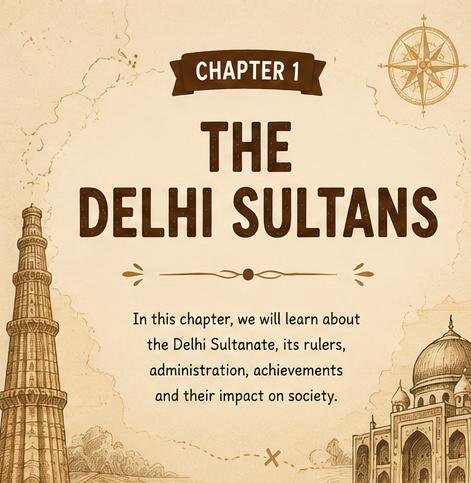
Chapter 1:
दिल्ली के सुल्तान
The Delhi Sultans
इस अध्याय में हम दिल्ली के सुल्तानों के उदय, उनके शासन तथा मध्यकालीन भारत पर उनके प्रभाव के बारे में जानेंगे।
In this chapter, we will learn about the rise of the Delhi Sultans, their administration, and how they shaped medieval India.
VIDEOS
The Delhi Sultans: Part 1
यह वीडियो दिल्ली सल्तनत की शुरुआत का परिचय देता है, जिसमें मुख्य रूप से ममलुक वंश के शासकों जैसे कुतुबुद्दीन ऐबक, इल्तुतमिश, रजिया सुल्तान और बलबन के साथ-साथ खिलजी वंश के विस्तार पर चर्चा की गई है।
This video introduces the origins of the Delhi Sultanate (1206–1526 AD), focusing on the foundational rulers of the Mamluk (Slave) Dynasty like Qutb-ud-din Aibak, Iltutmish, Razia Sultana, and Balban, alongside the expansions made by the Khalji Dynasty.
The Delhi Sultans: Part 2
.यह वीडियो दिल्ली सल्तनत के शेष राजवंशों—तुगलक, सैयद और लोदी वंश—का विवरण देता है, जो पानीपत के प्रथम युद्ध पर समाप्त होता है। इसके साथ ही इसमें सल्तनत कालीन प्रशासन, न्याय व्यवस्था, स्थापत्य कला और भू-राजस्व प्रणालियों को भी समझाया गया है।
This video covers the remaining dynasties of the Delhi Sultanate—the Tughlaq, Sayyid, and Lodi dynasties—concluding with the First Battle of Panipat, while also elaborating on the imperial administration, judicial structure, architectural styles, and land revenue systems.
NOTES
The Delhi Sultans
Introduction
The Delhi Sultanate was one of the most important periods in Indian history. It lasted from 1206 CE to 1526 CE and was ruled by five different dynasties. During this period, the Sultans expanded their kingdoms, introduced new administrative systems, encouraged trade, and promoted art and architecture.
Establishment of the Delhi Sultanate
Beginning of the Sultanate
The Delhi Sultanate was founded in 1206 CE by Qutb-ud-din Aibak, who established the Mamluk (Slave) Dynasty after the death of Muhammad Ghori.
The Sultanate ruled large parts of northern and central India for over 300 years.
The Five Dynasties
Major Ruling Dynasties
The Delhi Sultanate was ruled by the following five dynasties:
- Mamluk (Slave) Dynasty (1206–1290)
- Khalji Dynasty (1290–1320)
- Tughlaq Dynasty (1320–1414)
- Sayyid Dynasty (1414–1451)
- Lodi Dynasty (1451–1526)
Each dynasty contributed to the growth and administration of the Sultanate.
Administration
System of Government
The Sultan was the supreme ruler and was assisted by ministers and officials.
Important features of administration included:
- Division of the empire into provinces called Iqtas.
- Appointment of governors and military officers.
- Efficient tax collection.
- Maintenance of a strong army for security and expansion.
Important Rulers
Major Sultans
Some important rulers of the Delhi Sultanate were:
- Qutb-ud-din Aibak – Founder of the Delhi Sultanate.
- Iltutmish – Strengthened the Sultanate and introduced the silver tanka and copper jital coins.
- Razia Sultan – The first and only woman ruler of the Delhi Sultanate.
- Alauddin Khalji – Expanded the empire and introduced market control reforms.
- Muhammad bin Tughlaq – Known for ambitious but unsuccessful experiments.
- Firoz Shah Tughlaq – Built canals, gardens, and public buildings.
- Sikandar Lodi – Encouraged agriculture and administration.
Economy and Society
Trade and Agriculture
Agriculture was the main occupation of the people.
Other important activities included:
- Trade within India and with foreign countries.
- Growth of towns and markets.
- Development of handicrafts and textiles.
- Collection of land revenue by the government.
Art and Architecture
Architectural Achievements
The Delhi Sultans built many beautiful monuments.
Some famous examples are:
- Qutub Minar
- Alai Darwaza
- Tughlaqabad Fort
- Lodhi Gardens Tombs
These monuments show a blend of Indian and Islamic architectural styles.
Decline of the Delhi Sultanate
End of the Sultanate
The Delhi Sultanate gradually weakened because of:
- Weak rulers.
- Frequent rebellions.
- Internal conflicts.
- Foreign invasions.
In 1526 CE, Ibrahim Lodi was defeated by Babur in the First Battle of Panipat, leading to the establishment of the Mughal Empire.
Key Points
- The Delhi Sultanate lasted from 1206 CE to 1526 CE.
- It was ruled by five dynasties.
- Qutb-ud-din Aibak founded the Sultanate.
- Razia Sultan was the first woman ruler.
- Alauddin Khalji introduced important economic reforms.
- The Sultanate contributed greatly to administration, trade, and architecture.
- It ended after Babur defeated Ibrahim Lodi in 1526.
Chapter Summary
The Delhi Sultanate was a significant period in Indian history that lasted for more than three centuries. It was ruled by five dynasties that strengthened administration, expanded trade, and promoted art and architecture. The period witnessed the rule of famous rulers like Iltutmish, Razia Sultan, Alauddin Khalji, and Muhammad bin Tughlaq. The Sultanate came to an end in 1526 CE after Babur’s victory in the First Battle of Panipat, marking the beginning of the Mughal Empire.
दिल्ली के सुल्तान
परिचय
दिल्ली सल्तनत भारतीय इतिहास का एक महत्वपूर्ण काल था। इसका शासन 1206 ई. से 1526 ई. तक चला। इस दौरान पाँच अलग-अलग वंशों ने शासन किया। दिल्ली के सुल्तानों ने अपने राज्य का विस्तार किया, प्रशासन को संगठित बनाया, व्यापार को बढ़ावा दिया तथा कला और स्थापत्य के क्षेत्र में महत्वपूर्ण योगदान दिया।
दिल्ली सल्तनत की स्थापना
सल्तनत का प्रारंभ
1206 ई. में कुतुबुद्दीन ऐबक ने दिल्ली सल्तनत की स्थापना की। वह ममलूक (गुलाम) वंश का संस्थापक था और मुहम्मद गौरी की मृत्यु के बाद स्वतंत्र शासक बना।
दिल्ली सल्तनत ने लगभग 320 वर्षों तक उत्तरी और मध्य भारत के बड़े भाग पर शासन किया।
दिल्ली सल्तनत के पाँच वंश
प्रमुख राजवंश
दिल्ली सल्तनत पर निम्नलिखित पाँच वंशों ने शासन किया—
- ममलूक (गुलाम) वंश (1206–1290 ई.)
- खिलजी वंश (1290–1320 ई.)
- तुगलक वंश (1320–1414 ई.)
- सैयद वंश (1414–1451 ई.)
- लोदी वंश (1451–1526 ई.)
इन सभी वंशों ने प्रशासन और राज्य के विकास में महत्वपूर्ण योगदान दिया।
प्रशासन व्यवस्था
शासन प्रणाली
सल्तनत का सर्वोच्च शासक सुल्तान होता था। उसकी सहायता के लिए मंत्री और अधिकारी नियुक्त किए जाते थे।
प्रशासन की प्रमुख विशेषताएँ—
- राज्य को इक़्ता (Iqta) नामक प्रांतों में बाँटा गया था।
- प्रांतों में सूबेदार और सैन्य अधिकारी नियुक्त किए जाते थे।
- भूमि कर की व्यवस्था की गई।
- एक शक्तिशाली सेना का गठन किया गया।
प्रमुख शासक
महत्वपूर्ण सुल्तान
- कुतुबुद्दीन ऐबक – दिल्ली सल्तनत का संस्थापक।
- इल्तुतमिश – सल्तनत को मजबूत बनाया तथा टंका और जीटल सिक्के जारी किए।
- रज़िया सुल्तान – दिल्ली की पहली और एकमात्र महिला शासक।
- अलाउद्दीन खिलजी – साम्राज्य का विस्तार किया तथा बाजार नियंत्रण नीति लागू की।
- मुहम्मद बिन तुगलक – अपनी महत्वाकांक्षी योजनाओं के लिए प्रसिद्ध।
- फिरोज शाह तुगलक – नहरों, बागों और सार्वजनिक भवनों का निर्माण कराया।
- सिकंदर लोदी – कृषि और प्रशासन को प्रोत्साहन दिया।
अर्थव्यवस्था एवं समाज
व्यापार और कृषि
उस समय कृषि लोगों का मुख्य व्यवसाय था।
अन्य प्रमुख गतिविधियाँ—
- देश-विदेश के साथ व्यापार।
- नगरों और बाजारों का विकास।
- हस्तशिल्प और वस्त्र उद्योग की उन्नति।
- भूमि कर से राज्य की आय।
कला एवं स्थापत्य
स्थापत्य की उपलब्धियाँ
दिल्ली के सुल्तानों ने अनेक भव्य इमारतों का निर्माण कराया।
प्रमुख स्मारक—
- कुतुब मीनार
- अलाई दरवाज़ा
- तुगलकाबाद किला
- लोदी उद्यान के मकबरे
इन स्मारकों में भारतीय और इस्लामी स्थापत्य शैली का सुंदर समन्वय दिखाई देता है।
दिल्ली सल्तनत का पतन
सल्तनत का अंत
दिल्ली सल्तनत के पतन के प्रमुख कारण थे—
- कमजोर शासक।
- आंतरिक विद्रोह।
- राजनीतिक संघर्ष।
- विदेशी आक्रमण।
1526 ई. में पानीपत के प्रथम युद्ध में इब्राहिम लोदी को बाबर ने पराजित किया। इसके साथ ही दिल्ली सल्तनत का अंत हुआ और मुगल साम्राज्य की स्थापना हुई।
मुख्य बिंदु
- दिल्ली सल्तनत का शासन 1206–1526 ई. तक रहा।
- इस पर पाँच वंशों ने शासन किया।
- कुतुबुद्दीन ऐबक ने इसकी स्थापना की।
- रज़िया सुल्तान पहली महिला शासक थीं।
- अलाउद्दीन खिलजी ने महत्वपूर्ण आर्थिक सुधार किए।
- सल्तनत काल में प्रशासन, व्यापार और स्थापत्य कला का विकास हुआ।
- 1526 ई. में बाबर ने इब्राहिम लोदी को हराकर मुगल साम्राज्य की स्थापना की।
अध्याय सारांश
दिल्ली सल्तनत भारतीय इतिहास का एक महत्वपूर्ण काल था, जिसने लगभग तीन शताब्दियों तक भारत के बड़े भाग पर शासन किया। इस दौरान पाँच वंशों ने प्रशासन, व्यापार, कृषि तथा स्थापत्य कला के विकास में महत्वपूर्ण योगदान दिया। कुतुबुद्दीन ऐबक, इल्तुतमिश, रज़िया सुल्तान, अलाउद्दीन खिलजी और मुहम्मद बिन तुगलक जैसे शासकों ने इतिहास में विशेष स्थान बनाया। 1526 ई. में पानीपत के प्रथम युद्ध के बाद दिल्ली सल्तनत का अंत हुआ और मुगल शासन की शुरुआत हुई।