
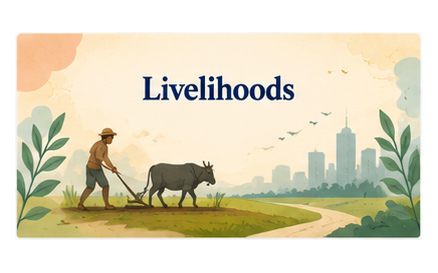
Livelihoods
Explore how people earn their livelihoods in villages and cities through farming, business, industries, and various occupations. Understand the importance of work, employment, and different sources of income in everyday life.
जानें कि गाँवों और शहरों में लोग खेती, व्यापार, उद्योग तथा विभिन्न व्यवसायों के माध्यम से अपनी आजीविका कैसे कमाते हैं। रोजगार, कार्य और आय के विभिन्न स्रोतों के महत्व को सरल उदाहरणों के माध्यम से समझें।
VIDEOS
Learn Livelihood through engaging video lessons covering rural occupations, urban jobs, farming, businesses, and different forms of employment.
भाग 1: ग्रामीण आजीविका
इस वीडियो में ग्रामीण क्षेत्रों में लोगों की आजीविका के प्रमुख साधनों की व्याख्या की गई है। विद्यार्थी कृषि मजदूरों, छोटे किसानों, बड़े भू-स्वामियों तथा खेती के अलावा अन्य ग्रामीण व्यवसायों के बारे में सीखते हैं।
Part 1: Rural Livelihoods
This video explains how people in villages earn their livelihoods through agriculture and related occupations. Students learn about agricultural labourers, small farmers, large landowners, and various non-farming occupations that support rural life and the village economy.
भाग 2: शहरी आजीविका
इस वीडियो में शहरों में लोगों द्वारा किए जाने वाले विभिन्न व्यवसायों का परिचय दिया गया है। विद्यार्थी रेहड़ी-पटरी विक्रेताओं, दुकानदारों, फैक्टरी श्रमिकों तथा दिहाड़ी मजदूरों के कार्य और उनके सामने आने वाली चुनौतियों को समझते हैं।
Part 2: Urban Livelihoods
This lesson introduces different types of urban livelihoods, including street vendors, shopkeepers, factory workers, and daily wage labourers. Students understand the challenges and opportunities faced by people working in cities and the importance of different occupations in urban life.
भाग 3: नियमित रोजगार और कार्यालयी कार्य
इस वीडियो में कार्यालयों, विद्यालयों, बैंकों, सरकारी विभागों तथा निजी कंपनियों में मिलने वाले नियमित रोजगार के बारे में बताया गया है। विद्यार्थी स्थायी नौकरी, नियमित वेतन, कर्मचारी सुविधाओं तथा नौकरी की सुरक्षा के महत्व को समझते हैं।
Part 3: Formal Employment and Office Jobs
This video explains permanent jobs in offices, schools, banks, government departments, and private companies. Students learn about regular salaries, employee benefits, job security, and how formal employment differs from temporary or casual work.
भाग 4: अभ्यास प्रश्न एवं पुनरावृत्ति
इस वीडियो में अध्याय से संबंधित महत्वपूर्ण अभ्यास प्रश्नों और पाठ्यपुस्तक के प्रश्नों की व्याख्या की गई है। विद्यार्थी ग्रामीण एवं शहरी आजीविका, विभिन्न व्यवसायों तथा नियमित और अस्थायी रोजगार के बीच के अंतर का पुनरावलोकन करते हैं।
Part 4: Practice Questions and Revision
This video revises the important concepts of rural and urban livelihoods through practice questions and textbook exercises. Students review different occupations, compare formal and informal employment, and strengthen their understanding of how people earn a living.
Livelihood
Learning Objectives
Students will understand the meaning of livelihood and explore how people earn their living in rural and urban areas. They will learn about farming, non-farming occupations, self-employment, formal employment, and the importance of different occupations in supporting society and the economy.
Introduction to Livelihood
A livelihood is the means through which people earn money to meet their daily needs such as food, clothing, education, healthcare, and shelter. Different people choose different occupations depending on their skills, education, resources, and the opportunities available where they live.
In India, livelihoods vary greatly between villages and cities. Rural areas mainly depend on agriculture, while urban areas offer a wider variety of jobs in industries, businesses, offices, and services.
Rural Livelihoods
Agriculture is the primary source of livelihood for most people living in villages. Farmers grow crops, raise livestock, and produce food for the country. Rural society includes small farmers, large landowners, and agricultural labourers, each playing an important role in agricultural production.
Many villagers also earn their income through non-farming activities such as pottery, weaving, carpentry, blacksmithing, basket making, dairy farming, animal husbandry, fishing, and small village industries. These occupations provide employment throughout the year and support the rural economy.
Urban Livelihoods
Cities provide many employment opportunities in trade, industries, transportation, construction, and services. Many people work as shopkeepers, factory workers, street vendors, drivers, mechanics, domestic workers, and daily wage labourers.
Urban livelihoods are diverse because cities have large populations and different economic activities. Some workers own their own businesses, while others work for employers in factories, offices, schools, hospitals, banks, and private companies.
Formal and Informal Employment
Employment can generally be divided into formal and informal sectors.
Formal employment includes permanent jobs in government departments, schools, banks, offices, and private companies. Employees usually receive fixed salaries, paid leave, medical benefits, provident fund, and job security.
Informal employment includes daily wage labourers, street vendors, construction workers, and many self-employed people. These workers often have irregular incomes, fewer benefits, and limited job security.
Importance of Livelihood
Every occupation contributes to the development of society. Farmers produce food, teachers educate children, doctors protect health, engineers build infrastructure, and workers support industries and businesses.
Respecting every profession is essential because each occupation plays a valuable role in improving the economy and the quality of life.
Challenges Faced by Workers
Many workers face challenges such as seasonal unemployment, low wages, financial insecurity, lack of social security, and limited access to education or healthcare. Governments introduce various welfare schemes and employment programs to improve the lives of workers and reduce poverty.
Understanding these challenges helps students appreciate the importance of equal opportunities and decent working conditions for everyone.
Practice Questions
- What is meant by livelihood?
- Name three rural occupations.
- Name three urban occupations.
- What is the difference between formal and informal employment?
- Why is every occupation important?
Answer Key
ANSWER 1
A livelihood is the means through which people earn money to meet their daily needs and support their families.
ANSWER 2
Three common rural occupations are farming, animal husbandry, and pottery.
ANSWER 3
Three common urban occupations are shopkeeping, factory work, and street vending.
ANSWER 4
Formal employment provides regular salaries, job security, and employee benefits, whereas informal employment usually offers irregular income and limited benefits.
ANSWER 5
Every occupation contributes to society by providing goods or services that support people’s daily lives and the country’s economic development.
आजीविका
सीखने के उद्देश्य
इस अध्याय में विद्यार्थी आजीविका के अर्थ को समझेंगे तथा जानेंगे कि गाँवों और शहरों में लोग विभिन्न व्यवसायों के माध्यम से अपनी जीविका कैसे कमाते हैं। वे कृषि, गैर-कृषि व्यवसाय, स्वरोजगार, नियमित रोजगार तथा समाज और अर्थव्यवस्था में विभिन्न व्यवसायों के महत्व का अध्ययन करेंगे।
परिचय
आजीविका वह साधन है जिसके माध्यम से लोग अपनी दैनिक आवश्यकताओं जैसे भोजन, वस्त्र, शिक्षा, स्वास्थ्य और आवास की पूर्ति के लिए आय अर्जित करते हैं। प्रत्येक व्यक्ति अपनी योग्यता, शिक्षा, संसाधनों और उपलब्ध अवसरों के अनुसार अलग-अलग व्यवसाय अपनाता है।
भारत में गाँवों और शहरों की आजीविका के साधन अलग-अलग हैं। ग्रामीण क्षेत्रों में मुख्य रूप से कृषि पर निर्भरता होती है, जबकि शहरों में उद्योग, व्यापार, सेवाएँ और कार्यालयों में अनेक प्रकार के रोजगार उपलब्ध होते हैं।
ग्रामीण आजीविका
ग्रामीण भारत में अधिकांश लोग कृषि से अपनी आजीविका कमाते हैं। किसान फसलें उगाते हैं, पशुपालन करते हैं तथा देश के लिए खाद्यान्न का उत्पादन करते हैं। ग्रामीण समाज में छोटे किसान, बड़े भू-स्वामी तथा कृषि मजदूर सभी कृषि व्यवस्था का महत्वपूर्ण हिस्सा हैं।
खेती के अतिरिक्त अनेक लोग कुम्हारी, बढ़ईगिरी, लुहारी, बुनाई, टोकरी बनाना, दुग्ध उत्पादन, मत्स्य पालन, पशुपालन तथा अन्य ग्रामीण उद्योगों से भी आय अर्जित करते हैं। ये व्यवसाय ग्रामीण अर्थव्यवस्था को मजबूत बनाते हैं।
शहरी आजीविका
शहरों में व्यापार, उद्योग, परिवहन, निर्माण कार्य तथा सेवा क्षेत्र में अनेक रोजगार उपलब्ध होते हैं। लोग दुकानदार, फैक्टरी श्रमिक, रेहड़ी-पटरी विक्रेता, चालक, मैकेनिक, घरेलू कर्मचारी तथा दिहाड़ी मजदूर के रूप में कार्य करते हैं।
शहरी क्षेत्रों में कुछ लोग स्वयं का व्यवसाय चलाते हैं, जबकि अनेक लोग विद्यालयों, अस्पतालों, बैंकों, सरकारी कार्यालयों तथा निजी कंपनियों में कार्य करते हैं।
नियमित और अनियमित रोजगार
रोजगार को मुख्य रूप से नियमित (औपचारिक) तथा अनियमित (अनौपचारिक) रोजगार में विभाजित किया जाता है।
नियमित रोजगार में कर्मचारियों को निश्चित वेतन, अवकाश, चिकित्सा सुविधाएँ, भविष्य निधि (PF) तथा नौकरी की सुरक्षा प्राप्त होती है। दूसरी ओर, अनियमित रोजगार में दिहाड़ी मजदूर, रेहड़ी-पटरी विक्रेता तथा अस्थायी श्रमिक शामिल होते हैं, जिनकी आय नियमित नहीं होती और उन्हें सीमित सुविधाएँ मिलती हैं।
आजीविका का महत्व
समाज के विकास में प्रत्येक व्यवसाय का महत्वपूर्ण योगदान होता है। किसान भोजन उपलब्ध कराते हैं, शिक्षक शिक्षा प्रदान करते हैं, चिकित्सक स्वास्थ्य सेवाएँ देते हैं, इंजीनियर आधारभूत संरचना का निर्माण करते हैं तथा श्रमिक उद्योगों और व्यापार को आगे बढ़ाते हैं।
इसलिए प्रत्येक व्यवसाय का सम्मान करना चाहिए क्योंकि सभी समाज और देश के विकास में महत्वपूर्ण भूमिका निभाते हैं।
श्रमिकों के सामने आने वाली चुनौतियाँ
अनेक श्रमिकों को मौसमी बेरोज़गारी, कम आय, आर्थिक असुरक्षा, सामाजिक सुरक्षा की कमी तथा शिक्षा और स्वास्थ्य सुविधाओं की सीमित उपलब्धता जैसी समस्याओं का सामना करना पड़ता है। सरकार विभिन्न रोजगार योजनाओं और कल्याणकारी कार्यक्रमों के माध्यम से उनके जीवन स्तर को बेहतर बनाने का प्रयास करती है।
इन चुनौतियों को समझने से विद्यार्थियों में श्रमिकों के प्रति सम्मान तथा समान अवसरों के महत्व की भावना विकसित होती है।
अभ्यास प्रश्न
- आजीविका से क्या अभिप्राय है?
- ग्रामीण क्षेत्रों के तीन प्रमुख व्यवसाय लिखिए।
- शहरी क्षेत्रों के तीन प्रमुख व्यवसाय लिखिए।
- नियमित और अनियमित रोजगार में क्या अंतर है?
- प्रत्येक व्यवसाय का महत्व क्यों है?
उत्तर
उत्तर 1
आजीविका वह साधन है जिसके माध्यम से व्यक्ति अपनी दैनिक आवश्यकताओं की पूर्ति के लिए आय अर्जित करता है।
उत्तर 2
ग्रामीण क्षेत्रों के प्रमुख व्यवसाय हैं—कृषि, पशुपालन तथा कुम्हारी।
उत्तर 3
शहरी क्षेत्रों के प्रमुख व्यवसाय हैं—दुकानदार, फैक्टरी श्रमिक तथा रेहड़ी-पटरी विक्रेता।
उत्तर 4
नियमित रोजगार में निश्चित वेतन, नौकरी की सुरक्षा तथा विभिन्न कर्मचारी सुविधाएँ मिलती हैं, जबकि अनियमित रोजगार में आय नियमित नहीं होती और सुविधाएँ भी सीमित होती हैं।
उत्तर 5
प्रत्येक व्यवसाय समाज को आवश्यक वस्तुएँ और सेवाएँ प्रदान करता है तथा देश के आर्थिक और सामाजिक विकास में महत्वपूर्ण योगदान देता है।