
Chapter 11:
शंकु परिच्छेद
Conic Section
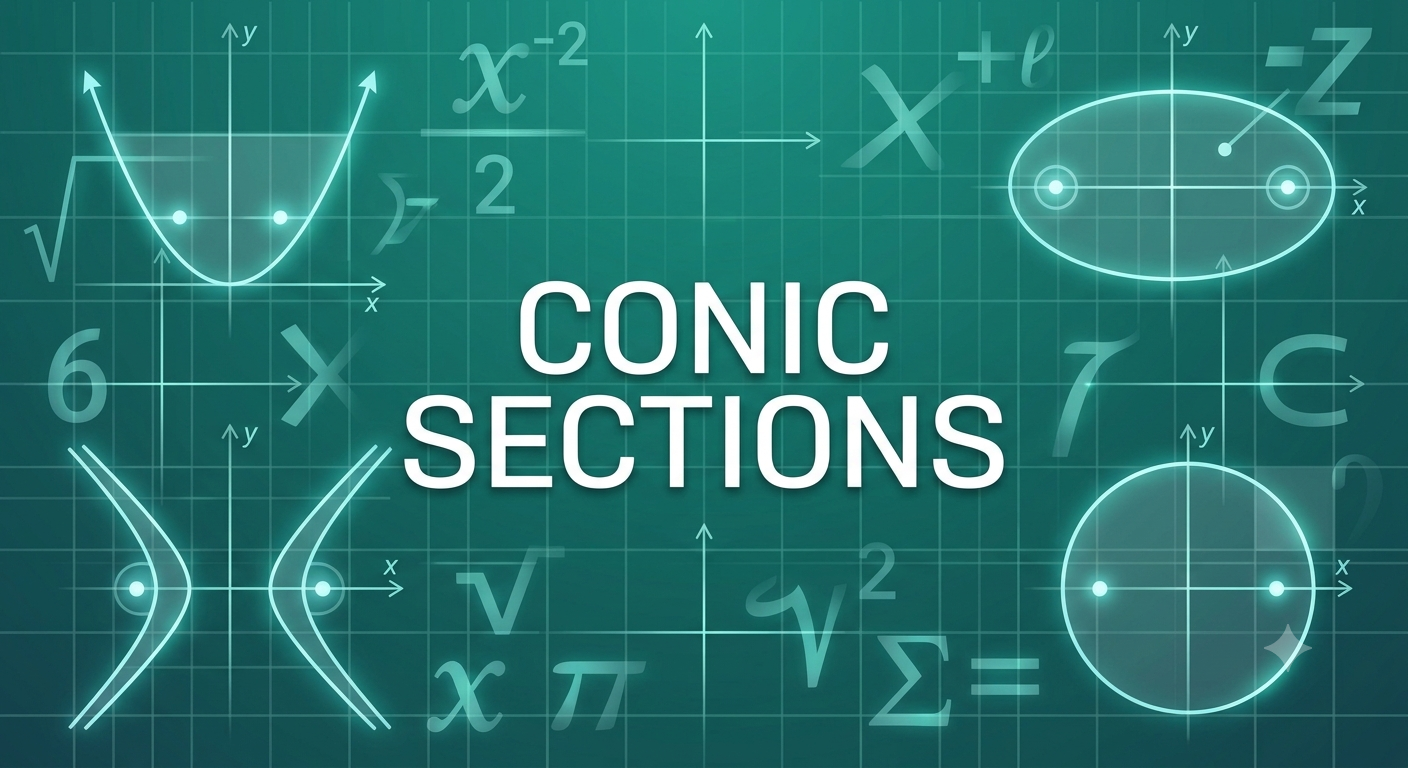
इस अध्याय में आप वृत्त, परवलय, दीर्घवृत्त तथा अतिपरवलय की समीकरणों और गुणों को समझेंगे। इनका उपयोग अभियांत्रिकी, खगोल विज्ञान तथा वास्तुकला सहित अनेक क्षेत्रों में किया जाता है।
In this chapter, you will study circles, parabolas, ellipses, and hyperbolas along with their equations and properties. These curves are widely used in engineering, astronomy, and architecture.
VIDEOS
Conic sections: Part 1
शंकु परिच्छेद (conic sections) की मूल अवधारणा का परिचय और वृत्त (circle) के मानक समीकरण तथा उसके गुणों पर ध्यान केंद्रित करना।
Introduces the concept of conic sections (sections of a cone) and focuses on the standard equation and properties of a circle.
Conic sections: Part 2
परवलय (parabola) की परिभाषा, अभिविन्यास (orientation) के आधार पर उसके मानक रूप, और उसके मुख्य घटकों जैसे नाभि (focus), नियता (directrix) और शीर्ष (vertex) की व्याख्या।
Explains the definition of a parabola, its standard forms based on orientation, and its essential components like focus, directrix, and vertex.
Conic sections: Part 3
दीर्घवृत्त (ellipse) की परिभाषा, मानक समीकरण और गुणों को कवर करना, जिसमें इसके दीर्घ/लघु अक्ष और उत्केन्द्रता (eccentricity) शामिल है।
Covers the definition, standard equations, and properties of an ellipse, including its major/minor axes and eccentricity.
Conic sections: Part 4
अतिपरवलय (hyperbola) की परिभाषा, मानक रूप और गुणों की चर्चा, जो इसे अन्य शंकु परिच्छेदों से अलग करती है।
Discusses the definition, standard forms, and properties of a hyperbola, distinguishing it from other conic sections.
NOTES
Conic Sections
Introduction
Conic Sections are curves obtained by cutting a right circular cone with a plane. Depending on the angle at which the plane intersects the cone, different curves such as a circle, parabola, ellipse, and hyperbola are formed. Conic sections have wide applications in astronomy, engineering, architecture, optics, and satellite communication.
Conic Section
What are Conic Sections?
A conic section is the curve formed when a plane cuts a double right circular cone.
The four main conic sections are:
- Circle
- Parabola
- Ellipse
- Hyperbola
Each has unique properties and equations.
Circle
Definition
A circle is the set of all points in a plane that are at a constant distance from a fixed point called the centre.
Standard equation:
(x − h)² + (y − k)² = r²
where:
- (h, k) = Centre
- r = Radius
Parabola
Definition
A parabola is the set of all points that are equidistant from a fixed point (Focus) and a fixed line (Directrix).
Important parts:
- Focus
- Directrix
- Vertex
- Axis of symmetry
Standard equation:
y² = 4ax
Ellipse
Definition
An ellipse is the set of all points for which the sum of the distances from two fixed points (Foci) is constant.
Important parts:
- Centre
- Major Axis
- Minor Axis
- Foci
- Vertices
Standard equation:
x²/a² + y²/b² = 1
where a > b.
Hyperbola
Definition
A hyperbola is the set of all points for which the difference of the distances from two fixed points (Foci) is constant.
Important parts:
- Centre
- Foci
- Vertices
- Asymptotes
Standard equation:
x²/a² − y²/b² = 1
Eccentricity
Meaning
Eccentricity (e) measures how much a conic section differs from a circle.
- Circle: e = 0
- Ellipse: 0 < e < 1
- Parabola: e = 1
- Hyperbola: e > 1
Degenerate Conics
Special Cases
When the cutting plane passes through the vertex of the cone, special curves called degenerate conics are formed, such as:
- A Point
- A Straight Line
- A Pair of Intersecting Lines
Applications of Conic Sections
Importance
Conic sections are used in:
- Astronomy
- Satellite Communication
- Architecture
- Engineering
- Physics
- Optics
- Design of Reflectors and Antennas
Key Points
- Conic sections are formed by intersecting a cone with a plane.
- The four conic sections are Circle, Parabola, Ellipse, and Hyperbola.
- A parabola is defined using a focus and directrix.
- An ellipse has two foci, and the sum of distances from them is constant.
- A hyperbola has two foci, and the difference of distances is constant.
- Eccentricity distinguishes different conic sections.
- Conic sections have many practical applications in science and engineering.
Chapter Summary
This chapter introduces conic sections and explains how they are formed by intersecting a cone with a plane. It covers the definitions, standard equations, and important features of the circle, parabola, ellipse, and hyperbola. The concept of eccentricity and degenerate conics is also discussed. Conic sections are widely used in mathematics, astronomy, engineering, and modern technology.
शंकु परिच्छेद (Conic Sections)
परिचय
शंकु परिच्छेद (Conic Sections) वे वक्र (Curves) हैं जो समकोण वृत्तीय शंकु (Right Circular Cone) को किसी समतल (Plane) से काटने पर प्राप्त होते हैं। समतल के झुकाव के अनुसार वृत्त, परवलय, दीर्घवृत्त तथा अतिपरवलय बनते हैं। इनका उपयोग खगोल विज्ञान, इंजीनियरिंग, वास्तुकला, प्रकाशिकी तथा उपग्रह संचार में किया जाता है।
शंकु परिच्छेद
शंकु परिच्छेद क्या है?
जब किसी द्वि-शंकु (Double Right Circular Cone) को एक समतल काटता है, तो जो वक्र प्राप्त होता है उसे शंकु परिच्छेद कहते हैं।
मुख्य चार प्रकार हैं—
- वृत्त (Circle)
- परवलय (Parabola)
- दीर्घवृत्त (Ellipse)
- अतिपरवलय (Hyperbola)
वृत्त (Circle)
परिभाषा
वृत्त उन सभी बिंदुओं का समुच्चय है जो एक निश्चित बिंदु (केंद्र) से समान दूरी पर स्थित होते हैं।
मानक समीकरण—
(x − h)² + (y − k)² = r²
जहाँ—
- (h, k) = केंद्र
- r = त्रिज्या
परवलय (Parabola)
परिभाषा
परवलय उन सभी बिंदुओं का समुच्चय है जो एक निश्चित बिंदु (Focus) तथा एक निश्चित रेखा (Directrix) से समान दूरी पर स्थित होते हैं।
मुख्य भाग—
- फोकस
- डायरेक्ट्रिक्स
- शीर्ष (Vertex)
- सममिति अक्ष
मानक समीकरण—
y² = 4ax
दीर्घवृत्त (Ellipse)
परिभाषा
दीर्घवृत्त उन सभी बिंदुओं का समुच्चय है जिनकी दो निश्चित बिंदुओं (Foci) से दूरियों का योग स्थिर रहता है।
मुख्य भाग—
- केंद्र
- प्रमुख अक्ष
- लघु अक्ष
- फोकस
- शीर्ष
मानक समीकरण—
x²/a² + y²/b² = 1
जहाँ a > b।
अतिपरवलय (Hyperbola)
परिभाषा
अतिपरवलय उन सभी बिंदुओं का समुच्चय है जिनकी दो निश्चित बिंदुओं (Foci) से दूरियों का अंतर स्थिर रहता है।
मुख्य भाग—
- केंद्र
- फोकस
- शीर्ष
- आसमटोट (Asymptotes)
मानक समीकरण—
x²/a² − y²/b² = 1
विलक्षणता (Eccentricity)
अर्थ
विलक्षणता (e) यह बताती है कि कोई शंकु परिच्छेद वृत्त से कितना भिन्न है।
- वृत्त: e = 0
- दीर्घवृत्त: 0 < e < 1
- परवलय: e = 1
- अतिपरवलय: e > 1
अपसारी शंकु परिच्छेद
Degenerate Conics
यदि समतल शंकु के शीर्ष से होकर गुजरता है, तो विशेष प्रकार के शंकु परिच्छेद बनते हैं, जैसे—
- बिंदु
- सीधी रेखा
- प्रतिच्छेदी रेखाओं का युग्म
शंकु परिच्छेद के अनुप्रयोग
महत्व
शंकु परिच्छेद का उपयोग—
- खगोल विज्ञान
- उपग्रह संचार
- वास्तुकला
- इंजीनियरिंग
- भौतिकी
- प्रकाशिकी
- परावर्तक एवं एंटीना निर्माण
में किया जाता है।
मुख्य बिंदु
- शंकु परिच्छेद शंकु को समतल से काटने पर बनते हैं।
- चार मुख्य प्रकार हैं— वृत्त, परवलय, दीर्घवृत्त और अतिपरवलय।
- परवलय की परिभाषा फोकस एवं डायरेक्ट्रिक्स पर आधारित है।
- दीर्घवृत्त में दो फोकस होते हैं तथा दूरियों का योग स्थिर रहता है।
- अतिपरवलय में दूरियों का अंतर स्थिर रहता है।
- विलक्षणता विभिन्न शंकु परिच्छेदों की पहचान कराती है।
- इनका उपयोग विज्ञान एवं इंजीनियरिंग में व्यापक रूप से होता है।
अध्याय सारांश
इस अध्याय में शंकु परिच्छेदों का परिचय, उनके निर्माण की प्रक्रिया, तथा वृत्त, परवलय, दीर्घवृत्त और अतिपरवलय की परिभाषाएँ एवं मानक समीकरणों का अध्ययन किया गया। साथ ही विलक्षणता (Eccentricity), अपसारी शंकु परिच्छेद तथा इनके व्यावहारिक अनुप्रयोगों को भी समझाया गया। यह अध्याय निर्देशांक ज्यामिति और उच्च गणित की महत्वपूर्ण नींव प्रदान करता है।