
Chapter 2
प्रारंभिक समाज – समय की शुरुआत से
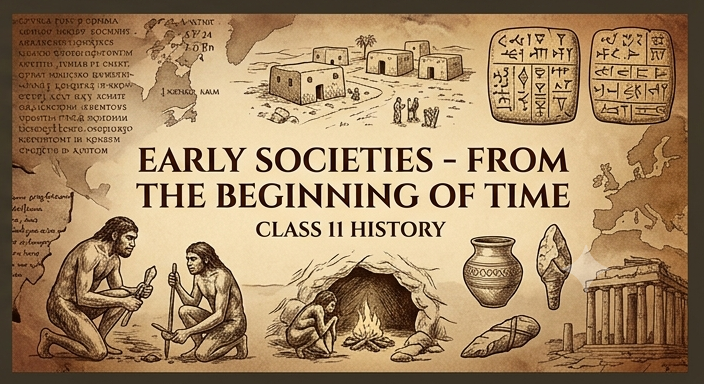
Early Societies – From the Beginning of Time
इस अध्याय में मानव समाज के प्रारंभिक विकास की यात्रा का अध्ययन किया जाएगा और यह समझा जाएगा कि प्राचीन काल में लोग किस प्रकार रहते, कार्य करते और अपने समाज को व्यवस्थित करते थे।
This chapter examines the development of early societies, their economies, social structures, and cultures, offering insights into the foundations of human civilisation.
VIDEOS
Early Societies – From the Beginning of Time: Part 1
आदिमानव के भौगोलिक फैलाव, विकास के सिद्धांत (प्रतिस्थापन बनाम क्षेत्रीय निरंतरता), और जीवाश्म, औजार व कार्बन डेटिंग जैसे ऐतिहासिक स्रोतों की व्याख्या।
Explores early human geographical spread, evolution theories (Replacement vs. Regional Continuity), and historical sources like fossils, tools, and carbon dating.
Early Societies – From the Beginning of Time: Part 2
होमिनिड्स से होमो सेपियंस तक के विकास का विवरण, जिसमें दो पैरों पर चलना, शारीरिक संरचना में बदलाव, और औजारों के उपयोग के साथ मस्तिष्क का विकास शामिल है।
Details the evolution from hominids to Homo sapiens, covering bipedalism, physical anatomical changes, and brain development related to tool usage.
NOTES
Early Societies – From the Beginning of Time
Introduction
Early human societies developed over millions of years. The history of humans begins with the evolution of early hominins, who gradually developed the ability to walk upright, use tools and communicate. Archaeological evidence, fossils and genetic studies help us understand the lives of early humans.
Human Evolution
Early Humans
Humans belong to the biological family called Hominidae. Human evolution took place over a very long period.
Some important early human species include:
- Australopithecus
- Homo habilis
- Homo erectus
- Homo sapiens
Early humans gradually developed larger brains, better tools and more complex social behaviour.
The Earliest Humans
Walking on Two Legs
One of the most important developments in human evolution was bipedalism, or the ability to walk on two legs.
Walking upright helped early humans:
- See their surroundings more clearly
- Carry food and tools
- Travel long distances
- Use their hands for other activities
Stone Tools
Importance of Tools
Early humans made tools mainly from stone, wood and bone. Stone tools were used for:
- Cutting meat
- Breaking bones
- Scraping animal skins
- Digging
- Hunting and gathering
The development of tools shows the growing intelligence and skills of early humans.
Homo Erectus and Fire
Discovery of Fire
Homo erectus was one of the early human species associated with the use of fire.
Fire was extremely important because it helped humans:
- Cook food
- Keep warm
- Protect themselves from wild animals
- Provide light
- Live in colder regions
Cooking also made food easier to digest.
Hunter-Gatherer Societies
Food Collection
For most of early human history, people lived as hunter-gatherers. They obtained food by hunting animals, fishing and collecting plants, fruits, roots and nuts.
They generally moved from one place to another in search of food and water. Therefore, they were nomadic.
Division of Work
Hunter-gatherer groups often divided work according to age, skills and physical abilities. Cooperation was essential for survival.
Language and Communication
Development of Communication
Early humans gradually developed different forms of communication. Language helped them:
- Share information
- Warn others of danger
- Teach skills
- Organise group activities
- Strengthen social relationships
The development of language was an important step in the growth of human societies.
Caves and Rock Art
Early Art
Early humans lived in caves and temporary shelters. They also created paintings and engravings on rocks.
Rock art often represented:
- Animals
- Hunting scenes
- Human figures
- Symbols
These paintings provide valuable information about the beliefs and activities of early humans.
Migration of Humans
Movement Across the World
Early humans gradually migrated from Africa to different parts of the world.
They moved in search of:
- Food
- Water
- Better climate
- New hunting grounds
Over thousands of years, humans spread across Asia, Europe, Australia and eventually the Americas.
The Beginning of Agriculture
Neolithic Revolution
Around 10,000 years ago, some human groups began to cultivate plants and domesticate animals.
This major change is often called the Neolithic Revolution.
Agriculture allowed people to:
- Produce their own food
- Live in permanent settlements
- Store surplus food
- Develop larger communities
Domestication of Animals
Animal Rearing
Humans began domesticating animals such as sheep, goats, cattle and dogs.
Animals provided:
- Meat
- Milk
- Wool
- Labour
- Protection
The domestication of plants and animals changed human life permanently.
Permanent Settlements
Village Life
With the development of agriculture, people began living in permanent villages. They built houses and developed new occupations.
Surplus food allowed some people to become:
- Potters
- Weavers
- Toolmakers
- Traders
This led to greater division of labour and social development.
Archaeological Evidence
Sources of Information
We learn about early societies through:
- Fossils
- Stone tools
- Bones
- Rock paintings
- Burial sites
- Archaeological remains
Scientists use these sources to reconstruct the lives of people who lived thousands or millions of years ago.
Key Points
- Human evolution took place over millions of years.
- Early humans gradually developed upright walking and larger brains.
- Stone tools were essential for survival.
- Fire helped humans cook food, stay warm and protect themselves.
- Hunter-gatherers depended on hunting, fishing and gathering.
- Early humans were generally nomadic.
- Language improved communication and cooperation.
- Rock paintings provide information about early human life.
- Humans migrated from Africa to different parts of the world.
- Agriculture and animal domestication began around 10,000 years ago.
- Farming led to permanent settlements and the growth of villages.
- Archaeological evidence helps us study early human societies.
Chapter Summary
Early human societies developed over millions of years through gradual biological and cultural changes. Early humans learned to walk upright, make tools, use fire and communicate. For a long time, people lived as nomadic hunter-gatherers. They gradually migrated from Africa to different parts of the world. Around 10,000 years ago, agriculture and animal domestication began, leading to permanent settlements, division of labour and the development of more complex societies. Fossils, tools, rock art and archaeological remains help us understand this important period of human history.
आदिम समाज – समय की शुरुआत से
परिचय
प्रारंभिक मानव समाजों का विकास लाखों वर्षों में हुआ। मानव इतिहास की शुरुआत प्रारंभिक होमिनिन के विकास से हुई, जिन्होंने धीरे-धीरे सीधा चलना, औजार बनाना और संचार करना सीखा। जीवाश्म, पुरातात्विक प्रमाण और आनुवंशिक अध्ययन हमें प्रारंभिक मनुष्यों के जीवन को समझने में सहायता करते हैं।
मानव विकास
प्रारंभिक मनुष्य
मनुष्य Hominidae नामक जैविक परिवार से संबंधित हैं। मानव विकास एक बहुत लंबी प्रक्रिया के दौरान हुआ।
मानव विकास की कुछ महत्वपूर्ण प्रजातियाँ थीं:
- ऑस्ट्रालोपिथेकस
- होमो हैबिलिस
- होमो इरेक्टस
- होमो सेपियन्स
प्रारंभिक मनुष्यों का मस्तिष्क धीरे-धीरे विकसित हुआ और उन्होंने बेहतर औजार तथा अधिक जटिल सामाजिक व्यवहार विकसित किए।
सबसे प्रारंभिक मनुष्य
दो पैरों पर चलना
मानव विकास में सबसे महत्वपूर्ण घटनाओं में से एक द्विपाद चलना था, अर्थात दो पैरों पर सीधा चलने की क्षमता।
सीधा चलने से प्रारंभिक मनुष्यों को:
- अपने आसपास को बेहतर ढंग से देखने
- भोजन और औजार ले जाने
- लंबी दूरी तय करने
- हाथों का अन्य कार्यों के लिए उपयोग करने
में सहायता मिली।
पत्थर के औजार
औजारों का महत्व
प्रारंभिक मनुष्य मुख्य रूप से पत्थर, लकड़ी और हड्डी से औजार बनाते थे। पत्थर के औजारों का उपयोग:
- मांस काटने
- हड्डियाँ तोड़ने
- जानवरों की खाल उतारने
- खुदाई करने
- शिकार और भोजन एकत्र करने
के लिए किया जाता था।
औजारों का विकास प्रारंभिक मनुष्यों की बढ़ती बुद्धि और कौशल को दर्शाता है।
होमो इरेक्टस और आग
आग की खोज
होमो इरेक्टस प्रारंभिक मानव प्रजातियों में से एक था, जिसे आग के उपयोग से जोड़ा जाता है।
आग बहुत महत्वपूर्ण थी क्योंकि इससे मनुष्य:
- भोजन पका सकते थे
- ठंड से बच सकते थे
- जंगली जानवरों से अपनी रक्षा कर सकते थे
- प्रकाश प्राप्त कर सकते थे
- ठंडे क्षेत्रों में रह सकते थे
खाना पकाने से भोजन पचाना भी आसान हो गया।
शिकारी-संग्रहकर्ता समाज
भोजन प्राप्त करना
प्रारंभिक मानव इतिहास के अधिकांश समय में लोग शिकारी-संग्रहकर्ता के रूप में रहते थे। वे शिकार, मछली पकड़ने तथा पौधों, फलों, जड़ों और कंदों को एकत्र करके भोजन प्राप्त करते थे।
भोजन और पानी की खोज में वे एक स्थान से दूसरे स्थान पर जाते थे। इसलिए वे सामान्यतः घुमंतू होते थे।
कार्य का विभाजन
शिकारी-संग्रहकर्ता समूहों में काम को आयु, कौशल और शारीरिक क्षमता के आधार पर बाँटा जाता था। जीवित रहने के लिए आपसी सहयोग आवश्यक था।
भाषा और संचार
संचार का विकास
प्रारंभिक मनुष्यों ने धीरे-धीरे संचार के विभिन्न तरीके विकसित किए। भाषा ने उन्हें:
- जानकारी साझा करने
- खतरे से दूसरों को सावधान करने
- कौशल सिखाने
- सामूहिक गतिविधियों को व्यवस्थित करने
- सामाजिक संबंध मजबूत करने
में सहायता की।
भाषा का विकास मानव समाज के विकास में एक महत्वपूर्ण कदम था।
गुफाएँ और शैल चित्र
प्रारंभिक कला
प्रारंभिक मनुष्य गुफाओं और अस्थायी आश्रयों में रहते थे। वे चट्टानों पर चित्र और नक्काशी भी बनाते थे।
शैल चित्रों में अक्सर दिखाया जाता था:
- जानवर
- शिकार के दृश्य
- मानव आकृतियाँ
- विभिन्न प्रतीक
ये चित्र प्रारंभिक मनुष्यों की गतिविधियों और विश्वासों के बारे में महत्वपूर्ण जानकारी देते हैं।
मनुष्यों का प्रवास
पूरी दुनिया में फैलाव
प्रारंभिक मनुष्य धीरे-धीरे अफ्रीका से निकलकर दुनिया के विभिन्न भागों में फैल गए।
वे निम्न कारणों से एक स्थान से दूसरे स्थान पर गए:
- भोजन की खोज
- पानी की उपलब्धता
- बेहतर जलवायु
- नए शिकार क्षेत्र
हजारों वर्षों में मनुष्य एशिया, यूरोप, ऑस्ट्रेलिया और अंततः अमेरिका तक फैल गए।
कृषि की शुरुआत
नवपाषाण क्रांति
लगभग 10,000 वर्ष पहले, कुछ मानव समूहों ने पौधों की खेती और जानवरों को पालतू बनाना शुरू किया।
इस महत्वपूर्ण परिवर्तन को अक्सर नवपाषाण क्रांति कहा जाता है।
कृषि के कारण मनुष्य:
- अपना भोजन स्वयं उत्पन्न करने
- स्थायी बस्तियों में रहने
- अतिरिक्त भोजन का भंडारण करने
- बड़े समुदाय विकसित करने
में सक्षम हुए।
जानवरों को पालतू बनाना
पशुपालन
मनुष्यों ने भेड़, बकरी, गाय और कुत्ते जैसे जानवरों को पालतू बनाना शुरू किया।
जानवरों से प्राप्त होता था:
- मांस
- दूध
- ऊन
- श्रम
- सुरक्षा
पौधों की खेती और जानवरों को पालतू बनाने से मानव जीवन में स्थायी परिवर्तन आया।
स्थायी बस्तियाँ
ग्राम जीवन
कृषि के विकास के साथ मनुष्य स्थायी गाँवों में रहने लगे। उन्होंने घर बनाए और नए व्यवसाय विकसित किए।
अतिरिक्त भोजन के कारण कुछ लोग निम्न कार्य करने लगे:
- मिट्टी के बर्तन बनाना
- बुनाई करना
- औजार बनाना
- व्यापार करना
इससे श्रम विभाजन और सामाजिक विकास को बढ़ावा मिला।
पुरातात्विक प्रमाण
जानकारी के स्रोत
हम प्रारंभिक समाजों के बारे में निम्न स्रोतों से जानकारी प्राप्त करते हैं:
- जीवाश्म
- पत्थर के औजार
- हड्डियाँ
- शैल चित्र
- कब्रों के अवशेष
- पुरातात्विक अवशेष
वैज्ञानिक इन प्रमाणों की सहायता से हजारों और लाखों वर्ष पहले रहने वाले लोगों के जीवन का पुनर्निर्माण करते हैं।
मुख्य बिंदु
- मानव विकास लाखों वर्षों में हुआ।
- प्रारंभिक मनुष्यों ने धीरे-धीरे सीधा चलना और बड़े मस्तिष्क का विकास किया।
- पत्थर के औजार जीवन-यापन के लिए महत्वपूर्ण थे।
- आग ने भोजन पकाने, गर्म रहने और सुरक्षा में सहायता की।
- शिकारी-संग्रहकर्ता शिकार, मछली पकड़ने और भोजन एकत्र करने पर निर्भर थे।
- प्रारंभिक मनुष्य सामान्यतः घुमंतू जीवन जीते थे।
- भाषा ने संचार और सहयोग को बेहतर बनाया।
- शैल चित्र प्रारंभिक मानव जीवन की जानकारी देते हैं।
- मनुष्य अफ्रीका से निकलकर दुनिया के विभिन्न भागों में फैल गए।
- लगभग 10,000 वर्ष पहले कृषि और पशुपालन की शुरुआत हुई।
- कृषि से स्थायी बस्तियों और गाँवों का विकास हुआ।
- जीवाश्म, औजार और पुरातात्विक प्रमाण प्रारंभिक मानव समाजों का अध्ययन करने में सहायक हैं।
अध्याय सारांश
प्रारंभिक मानव समाजों का विकास लाखों वर्षों में जैविक और सांस्कृतिक परिवर्तनों के माध्यम से हुआ। प्रारंभिक मनुष्यों ने सीधा चलना, औजार बनाना, आग का उपयोग करना और संचार करना सीखा। लंबे समय तक लोग घुमंतू शिकारी-संग्रहकर्ता के रूप में जीवन जीते रहे। धीरे-धीरे वे अफ्रीका से निकलकर दुनिया के विभिन्न भागों में फैल गए। लगभग 10,000 वर्ष पहले कृषि और पशुपालन की शुरुआत हुई, जिसके कारण स्थायी बस्तियाँ, श्रम विभाजन और अधिक जटिल समाजों का विकास हुआ। जीवाश्म, औजार, शैल चित्र और पुरातात्विक अवशेष हमें मानव इतिहास के इस महत्वपूर्ण काल को समझने में सहायता करते हैं।