
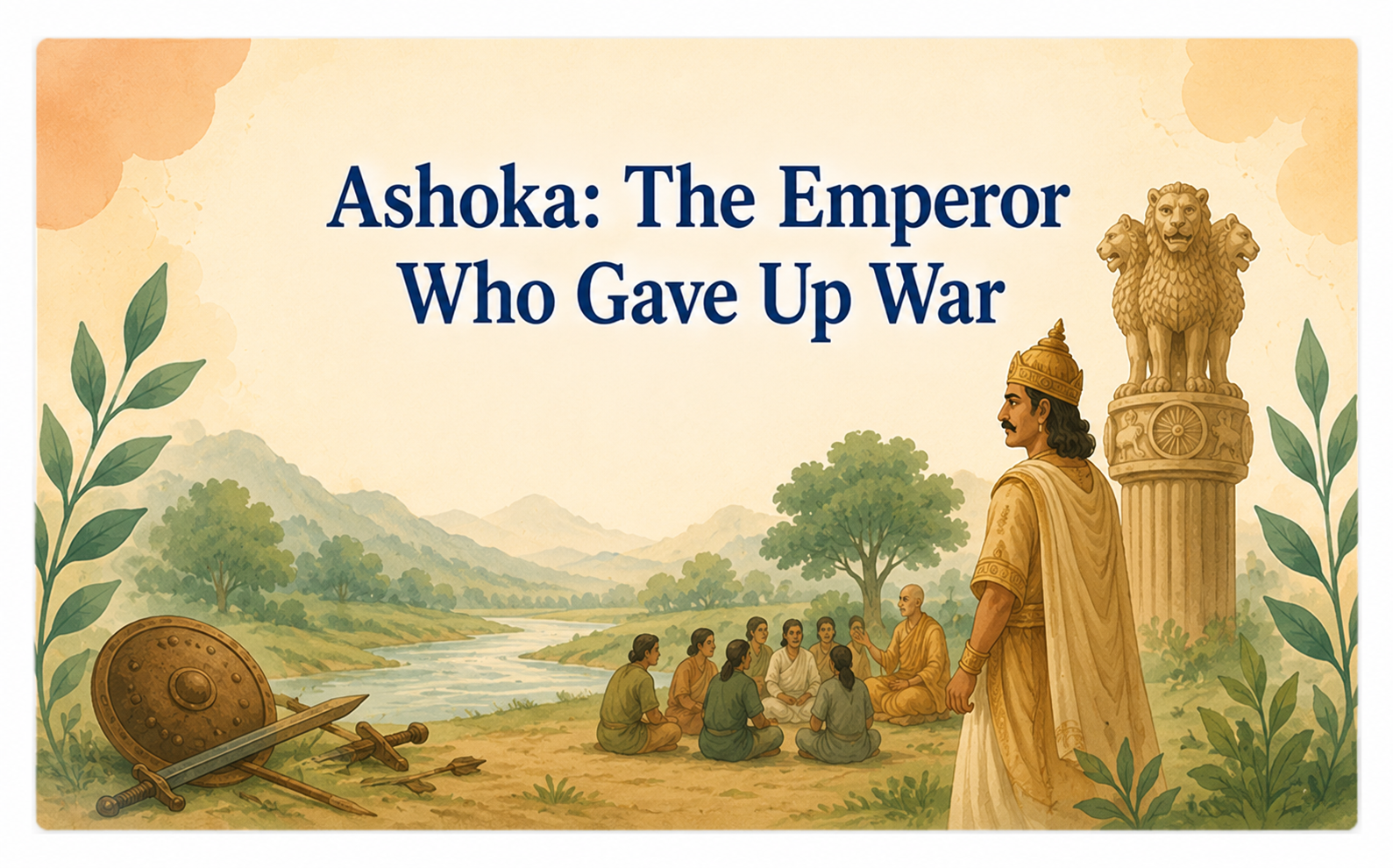
Ashoka: The Emperor Who Gave Up War
Discover the rise of the Mauryan Empire and the inspiring journey of Emperor Ashoka through engaging lessons covering administration, inscriptions, the Kalinga War, and the principles of Dhamma.
मौर्य साम्राज्य और सम्राट अशोक के जीवन का अध्ययन करें। इस अध्याय में मौर्य प्रशासन, अभिलेखों का महत्व, कलिंग युद्ध तथा अशोक के धम्म और शांति के संदेश को सरल भाषा में समझाया गया है।
VIDEOS
Learn The Mauryan Empire and Ashoka’s Dhamma through interactive video lessons covering the Mauryan rulers, administration, inscriptions, the Kalinga War, and Ashoka’s message of peace and good governance.
भाग 1: मौर्य साम्राज्य और उसका प्रशासन
इस वीडियो में मौर्य साम्राज्य तथा उसके महान शासकों—चंद्रगुप्त मौर्य, बिंदुसार और सम्राट अशोक—का परिचय दिया गया है। विद्यार्थी भारत के प्रथम विशाल साम्राज्य, पाटलिपुत्र, तक्षशिला और उज्जैन जैसे प्रमुख नगरों तथा अभिलेखों के माध्यम से शासन व्यवस्था को समझते हैं।
Part 1: The Mauryan Empire and Its Administration
This video introduces the Mauryan Empire and its powerful rulers—Chandragupta Maurya, Bindusara, and Ashoka. Students learn how India’s first great empire was governed, the importance of major cities like Pataliputra, Taxila, and Ujjain, and how inscriptions were used to communicate with the people.
भाग 2: कलिंग युद्ध और अशोक का धम्म
इस वीडियो में कलिंग युद्ध तथा उसके बाद सम्राट अशोक के जीवन में आए महान परिवर्तन का अध्ययन कराया गया है। विद्यार्थी धम्म के सिद्धांतों, शांति, धार्मिक सहिष्णुता, करुणा तथा अशोक द्वारा भारत और अन्य देशों में इन मूल्यों के प्रसार को समझते हैं।
Part 2: The Kalinga War and Ashoka’s Dhamma
This lesson explains the historic Kalinga War and the transformation of Emperor Ashoka after witnessing its destruction. Students learn about the principles of Dhamma, the promotion of peace, religious tolerance, compassion, and how Ashoka spread these values across India and other countries.
The Mauryas and Ashoka’s
Dhamma
Learning Objectives
Understand the rise of the Mauryan Empire and the contributions of Chandragupta Maurya, Bindusara, and Emperor Ashoka. Learn about the administration of the Mauryan Empire, the importance of inscriptions, the Kalinga War, and Ashoka’s Dhamma. Explore how Ashoka promoted peace, religious tolerance, and good governance throughout his empire and beyond.
Introduction to the Mauryan Empire
The Mauryan Empire was the first great empire to unite a large part of the Indian subcontinent under one powerful administration. Established around 2,300 years ago, it marked a significant milestone in Indian history by introducing a strong central government, an organized administrative system, and an efficient network of officials.
The Mauryan rulers expanded trade, maintained law and order, built roads, and encouraged communication across distant regions. Their achievements laid the foundation for political unity and good governance in ancient India. Among all the Mauryan rulers, Emperor Ashoka is remembered as one of the greatest kings in world history because of his commitment to peace and humanity.
Chandragupta Maurya and the Foundation of the Empire
The Mauryan Empire was founded by Chandragupta Maurya with the guidance of his teacher and advisor Chanakya, also known as Kautilya. Together, they defeated the Nanda rulers and established a vast empire that stretched across much of northern India.
After Chandragupta, the empire was ruled by his son Bindusara, who further strengthened the kingdom and expanded its territories. Later, Bindusara’s son Ashoka became one of the most influential rulers in Indian history.
The Mauryan Empire was much larger than the earlier kingdoms and required a highly organized administration to govern its vast territories effectively.
Administration of the Mauryan Empire
The Mauryan rulers established several important administrative and commercial centers across the empire. The capital city was Pataliputra (present-day Patna), which served as the political and administrative headquarters.
Other major cities included Taxila, an important center connecting India with Central Asia through trade routes, and Ujjain, a significant commercial city linking northern and southern India. These cities played an important role in administration, trade, education, and communication.
To manage such a large empire, the rulers appointed numerous officials to collect taxes, supervise trade, maintain law and order, and ensure that royal policies were implemented throughout the kingdom. A strong army protected the empire from external attacks and maintained internal security.
Kingdoms and Empires
A kingdom is generally a smaller territory ruled by a king, while an empire consists of many kingdoms or regions brought under the control of a single ruler. Because empires cover vast areas and include diverse populations, they require more complex administrative systems than ordinary kingdoms.
The Mauryan Empire developed an efficient taxation system, maintained a large standing army, and established a network of officials to govern different provinces. These administrative improvements helped maintain unity and stability across the empire.
Ashoka’s Inscriptions
One of Emperor Ashoka’s greatest contributions was his use of inscriptions to communicate directly with his people. Unlike earlier rulers, Ashoka had his messages carved on rocks and stone pillars placed throughout his empire.
Most of these inscriptions were written in the Prakrit language using the Brahmi script, making them understandable to ordinary people. Through these inscriptions, Ashoka shared instructions about good conduct, honesty, compassion, religious tolerance, and responsible citizenship.
Today, these inscriptions serve as valuable historical sources that help historians understand the administration, beliefs, and policies of the Mauryan Empire.
The Kalinga War
One of the most significant events in Ashoka’s life was the Kalinga War, fought against the kingdom of Kalinga in present-day Odisha. Although Ashoka won the war, it resulted in enormous destruction and the loss of thousands of lives.
After witnessing the suffering caused by the conflict, Ashoka experienced deep sorrow and regret. Instead of celebrating his victory, he realized that violence brought only pain and misery. This life-changing experience transformed his outlook and changed the course of Indian history.
Ashoka became one of the very few rulers in history who willingly abandoned wars of conquest after achieving military success.
Ashoka’s Dhamma
Following the Kalinga War, Ashoka adopted the peaceful teachings of Buddhism and devoted himself to spreading Dhamma, meaning righteous conduct or moral living. His Dhamma was not intended to establish a new religion but to encourage ethical values that everyone could follow.
Ashoka taught people to respect parents and elders, treat servants and animals with kindness, always speak the truth, avoid unnecessary violence, and maintain harmony among followers of different religions. He believed that a ruler should care for his people just as a father cares for his children.
His policy of Dhamma promoted compassion, tolerance, honesty, self-discipline, and mutual respect throughout society.
Spread of Dhamma
To spread these values across the empire, Ashoka appointed special officers known as Dhamma Mahamattas. These officials travelled to villages and towns, educating people about moral behavior and resolving social disputes peacefully.
Ashoka also sent messengers to neighboring kingdoms and distant countries such as Sri Lanka, Syria, Egypt, and Greece to share his message of peace and goodwill. These efforts helped spread Indian culture and Buddhist teachings beyond the borders of the Mauryan Empire.
Importance of the Mauryan Empire and Ashoka
The Mauryan Empire demonstrated how a vast territory could be governed through efficient administration and organized institutions. Ashoka’s transformation after the Kalinga War remains one of history’s most remarkable examples of leadership based on compassion rather than military power.
His ideas of peace, religious tolerance, justice, and public welfare continue to inspire people around the world. The inscriptions, monuments, and historical records left behind by Ashoka remain among the most valuable sources for understanding ancient Indian history.
Practice Questions
- Who founded the Mauryan Empire?
- Name the capital city of the Mauryan Empire.
- Why are Ashoka’s inscriptions important?
- How did the Kalinga War change Ashoka’s life?
- What were the main principles of Ashoka’s Dhamma?
Answer Key
ANSWER 1
The Mauryan Empire was founded by Chandragupta Maurya with the guidance of Chanakya (Kautilya).
ANSWER 2
The capital city of the Mauryan Empire was Pataliputra, present-day Patna.
ANSWER 3
Ashoka’s inscriptions are important because they provide valuable information about his administration, policies, and the principles of Dhamma.
ANSWER 4
After witnessing the destruction and suffering caused by the Kalinga War, Ashoka gave up violence and dedicated his life to promoting peace and moral values through Dhamma.
ANSWER 5
Ashoka’s Dhamma emphasized kindness, truthfulness, respect for elders, compassion towards animals, religious tolerance, peaceful living, and concern for the welfare of all people.
मौर्य साम्राज्र्य और अशोक का धम्म
सीखने के उद्देश्य
मौर्य साम्राज्य के उदय तथा चंद्रगुप्त मौर्य, बिंदुसार और सम्राट अशोक के योगदान को समझें। मौर्य प्रशासन, अभिलेखों के महत्व, कलिंग युद्ध तथा अशोक के धम्म का अध्ययन करें। जानें कि अशोक ने शांति, धार्मिक सहिष्णुता और जनकल्याण के सिद्धांतों को पूरे साम्राज्य और अन्य देशों तक कैसे पहुँचाया।
मौर्य साम्राज्य का परिचय
मौर्य साम्राज्य भारत का पहला विशाल साम्राज्य था जिसने भारतीय उपमहाद्वीप के बड़े भाग को एक संगठित शासन व्यवस्था के अंतर्गत एकजुट किया। लगभग 2300 वर्ष पूर्व स्थापित इस साम्राज्य ने मजबूत प्रशासन, प्रभावी कर व्यवस्था, सुव्यवस्थित संचार तथा कानून व्यवस्था की नई परंपराएँ विकसित कीं।
मौर्य शासकों ने व्यापार को बढ़ावा दिया, सड़कों का निर्माण कराया, प्रशासन को संगठित किया और विशाल साम्राज्य में एकता बनाए रखी। इन शासकों में सम्राट अशोक का स्थान सबसे महत्वपूर्ण माना जाता है, क्योंकि उन्होंने युद्ध छोड़कर शांति और मानवता का मार्ग अपनाया।
चंद्रगुप्त मौर्य और साम्राज्य की स्थापना
चंद्रगुप्त मौर्य ने अपने गुरु और सलाहकार चाणक्य (कौटिल्य) की सहायता से नंद वंश को पराजित कर मौर्य साम्राज्य की स्थापना की। उनके नेतृत्व में भारत का पहला विशाल साम्राज्य अस्तित्व में आया।
चंद्रगुप्त के बाद उनके पुत्र बिंदुसार शासक बने। उनके पश्चात सम्राट अशोक ने शासन संभाला और मौर्य साम्राज्य को नई ऊँचाइयों तक पहुँचाया।
मौर्य साम्राज्य पहले के राज्यों की तुलना में कहीं अधिक विशाल था, इसलिए इसके संचालन के लिए अत्यंत संगठित प्रशासन की आवश्यकता थी।
मौर्य प्रशासन
मौर्य साम्राज्य की राजधानी पाटलिपुत्र (वर्तमान पटना) थी, जो प्रशासन और शासन का प्रमुख केंद्र था।
इसके अतिरिक्त तक्षशिला और उज्जैन जैसे महत्वपूर्ण नगर व्यापार, प्रशासन और संचार के प्रमुख केंद्र थे। इन नगरों के माध्यम से साम्राज्य के विभिन्न क्षेत्रों का संचालन किया जाता था।
साम्राज्य के सुचारु संचालन के लिए अनेक अधिकारियों की नियुक्ति की गई थी, जो कर संग्रह, कानून व्यवस्था, व्यापार, न्याय और सार्वजनिक कार्यों की देखरेख करते थे। विशाल सेना साम्राज्य की सुरक्षा सुनिश्चित करती थी।
राज्य और साम्राज्य में अंतर
राज्य सामान्यतः सीमित क्षेत्र वाला होता है, जबकि साम्राज्य अनेक राज्यों या प्रदेशों को मिलाकर बनाया जाता है। बड़े साम्राज्य के संचालन के लिए अधिक अधिकारियों, बड़ी सेना, प्रभावी कर व्यवस्था तथा मजबूत प्रशासन की आवश्यकता होती है।
मौर्य साम्राज्य ने इन सभी व्यवस्थाओं को सफलतापूर्वक विकसित किया, जिसके कारण वह लंबे समय तक संगठित और शक्तिशाली बना रहा।
अशोक के अभिलेख
सम्राट अशोक पहले ऐसे भारतीय शासक थे जिन्होंने अपने संदेश सीधे जनता तक पहुँचाने के लिए शिलालेखों और स्तंभलेखों का उपयोग किया। उन्होंने अपने आदेश और नैतिक संदेश पत्थरों तथा स्तंभों पर खुदवाए।
इन अभिलेखों का अधिकांश भाग प्राकृत भाषा में ब्राह्मी लिपि का उपयोग करके लिखा गया था, जिससे सामान्य लोग भी उन्हें समझ सकें। आज ये अभिलेख इतिहासकारों के लिए मौर्य प्रशासन और अशोक की नीतियों के महत्वपूर्ण स्रोत हैं।
कलिंग युद्ध
सम्राट अशोक के जीवन की सबसे महत्वपूर्ण घटना कलिंग युद्ध थी, जो वर्तमान ओडिशा के कलिंग राज्य के विरुद्ध लड़ा गया था। यद्यपि अशोक इस युद्ध में विजयी हुए, लेकिन युद्ध में हुई भारी जनहानि और विनाश ने उन्हें अत्यंत दुखी कर दिया।
उन्होंने महसूस किया कि युद्ध केवल पीड़ा और विनाश लाता है। इस अनुभव ने उनके जीवन की दिशा बदल दी और उन्होंने भविष्य में हिंसा का मार्ग त्यागने का निर्णय लिया।
अशोक का धम्म
कलिंग युद्ध के बाद अशोक ने बौद्ध धर्म की शिक्षाओं से प्रेरणा लेकर धम्म को अपनाया। उनका धम्म किसी नए धर्म की स्थापना नहीं था, बल्कि नैतिक जीवन जीने का एक मार्ग था।
उन्होंने लोगों को माता-पिता और बड़ों का सम्मान करने, पशुओं और सेवकों के प्रति दया रखने, सत्य बोलने, धार्मिक सहिष्णुता अपनाने तथा सभी धर्मों का सम्मान करने की शिक्षा दी। उनका विश्वास था कि एक शासक को अपनी प्रजा की देखभाल उसी प्रकार करनी चाहिए जैसे एक पिता अपने बच्चों की करता है।
धम्म का प्रसार
अशोक ने अपने धम्म का प्रचार करने के लिए धम्म महामात्रों की नियुक्ति की। ये अधिकारी गाँव-गाँव जाकर लोगों को नैतिक जीवन, सदाचार और सामाजिक सद्भाव का संदेश देते थे।
उन्होंने अपने दूतों को श्रीलंका, सीरिया, मिस्र और यूनान जैसे देशों में भी भेजा ताकि शांति, सद्भाव और बौद्ध शिक्षाओं का प्रसार किया जा सके।
मौर्य साम्राज्य और अशोक का महत्व
मौर्य साम्राज्य ने यह सिद्ध किया कि विशाल क्षेत्रों का शासन संगठित प्रशासन और प्रभावी व्यवस्था से सफलतापूर्वक किया जा सकता है। सम्राट अशोक का युद्ध से शांति की ओर परिवर्तन विश्व इतिहास की सबसे प्रेरणादायक घटनाओं में से एक माना जाता है।
उनके शांति, करुणा, धार्मिक सहिष्णुता और जनकल्याण के सिद्धांत आज भी पूरे विश्व में प्रेरणा का स्रोत हैं। उनके अभिलेख और स्मारक प्राचीन भारतीय इतिहास के सबसे महत्वपूर्ण स्रोतों में गिने जाते हैं।
अभ्यास प्रश्न
- मौर्य साम्राज्य की स्थापना किसने की?
- मौर्य साम्राज्य की राजधानी का नाम क्या था?
- अशोक के अभिलेखों का महत्व क्या है?
- कलिंग युद्ध ने अशोक के जीवन को कैसे बदल दिया?
- अशोक के धम्म के मुख्य सिद्धांत क्या थे?
उत्तर
उत्तर 1
मौर्य साम्राज्य की स्थापना चंद्रगुप्त मौर्य ने अपने गुरु चाणक्य (कौटिल्य) की सहायता से की।
उत्तर 2
मौर्य साम्राज्य की राजधानी पाटलिपुत्र (वर्तमान पटना) थी।
उत्तर 3
अशोक के अभिलेख उनके प्रशासन, नीतियों तथा धम्म के सिद्धांतों की महत्वपूर्ण जानकारी प्रदान करते हैं।
उत्तर 4
कलिंग युद्ध के विनाश और जनहानि को देखकर अशोक ने हिंसा का त्याग किया और शांति तथा धम्म के प्रचार में अपना जीवन समर्पित कर दिया।
उत्तर 5
अशोक के धम्म के प्रमुख सिद्धांत थे—सत्य बोलना, बड़ों का सम्मान करना, सभी धर्मों का आदर करना, पशुओं और मनुष्यों के प्रति दया रखना तथा शांति और सद्भाव के साथ जीवन जीना।मग्री।