
CHAPTER 2
SQUARES AND SQUARE ROOTS
Master Squares and Square Roots through engaging lessons covering perfect squares, number patterns, Pythagorean triplets, shortcut methods for squaring numbers, and efficient techniques to find square roots.
वर्ग और वर्गमूल अध्याय में पूर्ण वर्ग संख्याओं के गुण, रोचक संख्या प्रतिरूप, पाइथागोरीय त्रिक, संख्याओं के वर्ग ज्ञात करने की सरल युक्तियाँ तथा विभिन्न विधियों से वर्गमूल निकालना विस्तार से सीखें।
VIDEOS
Learn Squares and Square Roots through interactive video lessons covering perfect squares, number patterns, Pythagorean triplets, and methods to find square roots with ease.
भाग 1: पूर्ण वर्ग संख्याओं के गुण
इस वीडियो में पूर्ण वर्ग संख्याओं का परिचय तथा उनके महत्वपूर्ण गुणों को समझाया गया है। विद्यार्थी इकाई अंक के आधार पर पूर्ण वर्ग संख्याओं की पहचान करना, सम और विषम संख्याओं के वर्गों के गुण तथा शून्यों के आधार पर पूर्ण वर्ग की पहचान करना सीखते हैं।
Part 1: Properties of Square Numbers
This video introduces perfect square numbers and explains their important properties. Students learn how to identify square numbers by observing their unit digits, understand patterns involving even and odd numbers, and determine whether a number can be a perfect square based on the number of trailing zeros.
भाग 2: वर्ग संख्याओं के रोचक प्रतिरूप
इस वीडियो में वर्ग संख्याओं से जुड़े विभिन्न गणितीय प्रतिरूपों की व्याख्या की गई है। विद्यार्थी क्रमागत विषम संख्याओं के योग, लगातार दो पूर्ण वर्गों के बीच आने वाली संख्याओं तथा त्रिभुजाकार संख्याओं और पूर्ण वर्गों के संबंध को सरल उदाहरणों के माध्यम से समझते हैं।
Part 2: Patterns in Square Numbers
This lesson explores interesting mathematical patterns related to square numbers. Students learn how consecutive odd numbers form perfect squares, discover the relationship between consecutive square numbers, and understand how triangular numbers are connected to perfect squares through simple examples.
भाग 3: पाइथागोरीय त्रिक और वर्ग ज्ञात करने की युक्तियाँ
इस पाठ में पाइथागोरीय त्रिक की अवधारणा तथा उसके उपयोग को समझाया गया है। साथ ही 5 पर समाप्त होने वाली संख्याओं का वर्ग शीघ्रता से ज्ञात करने की आसान युक्ति भी सिखाई गई है, जिससे मानसिक गणना अधिक सरल हो जाती है।
Part 3: Pythagorean Triplets and Shortcut Methods
This video explains the concept of Pythagorean triplets and shows how they satisfy the famous Pythagoras relationship. Students also learn a quick shortcut for finding the square of numbers ending in 5, making mental calculations faster and easier.
भाग 4: वर्गमूल ज्ञात करने की विधियाँ
इस अंतिम वीडियो में वर्गमूल की अवधारणा तथा उसे ज्ञात करने की विभिन्न विधियों का अध्ययन कराया गया है। विद्यार्थी बार-बार घटाने की विधि तथा अभाज्य गुणनखंडन विधि द्वारा वर्गमूल निकालना सीखते हैं और उदाहरणों के माध्यम से इन विधियों का अभ्यास करते हैं.
Part 4: Finding Square Roots
This final lesson introduces square roots as the inverse of squaring. Students learn how to calculate square roots using repeated subtraction and prime factorization methods, solve textbook problems step by step, and build confidence in finding square roots of perfect square numbers.
Squares and Square Roots
Learning Objectives
Understand the concept of square numbers and square roots. Learn the properties and patterns of perfect squares, identify square numbers quickly, generate Pythagorean triplets, calculate the square of numbers ending in 5, and find square roots using repeated subtraction and prime factorization methods.
Introduction to Squares and Square Roots
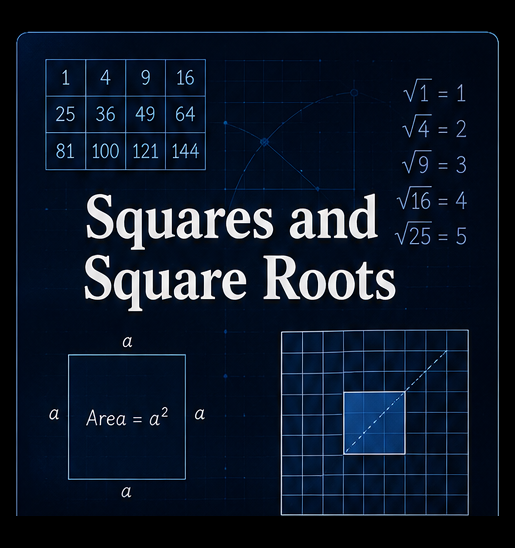
Squares and square roots are important concepts in mathematics that appear in algebra, geometry, mensuration, and higher-level calculations. A square number is obtained by multiplying a number by itself, while a square root is the number that, when multiplied by itself, produces the original number. Understanding these concepts helps students solve mathematical problems more efficiently and builds a strong foundation for advanced topics.
Perfect squares follow several interesting patterns and mathematical properties that make calculations faster and easier. Learning these patterns also improves mental mathematics and problem-solving skills.
Understanding Square Numbers
A square number, also known as a perfect square, is obtained when a natural number is multiplied by itself. For example, 5×5=25, so 25 is a perfect square. Similarly, 12×12=144, making 144 another perfect square.
Perfect squares have unique properties that help identify them quickly. A square number can only end with the digits 0, 1, 4, 5, 6, or 9. Numbers ending in 2, 3, 7, or 8 can never be perfect squares. Similarly, a perfect square can only end with an even number of zeros. If a number ends with an odd number of zeros, it cannot be a perfect square.
Another important property is that the square of an even number is always even, while the square of an odd number is always odd. These simple observations help students recognize perfect squares without performing lengthy calculations.
Interesting Patterns in Square Numbers
Square numbers follow several fascinating mathematical patterns. One of the most important is that the sum of the first n consecutive odd numbers always equals n². For example,
1 + 3 + 5 + 7 + 9 = 25 = 5²
Another useful pattern is that between the squares of two consecutive natural numbers, there are exactly 2n non-square numbers. For example, between 3² = 9 and 4² = 16, there are six numbers (10, 11, 12, 13, 14, and 15).
Students also learn that adding two consecutive triangular numbers always produces a perfect square. These mathematical relationships make it easier to identify patterns and understand how numbers are connected.
Pythagorean Triplets and Squares Ending in 5
A Pythagorean Triplet consists of three natural numbers that satisfy the equation:
a² + b² = c²
Examples include (3, 4, 5) and (5, 12, 13). A general formula can also be used to generate many Pythagorean triplets:
(2m, m² − 1, m² + 1) where m > 1.
Students also learn a quick shortcut for finding the square of numbers ending in 5. Multiply the digit before 5 by its next consecutive number and write 25 at the end.
For example,
25² = 625
35² = 1225
75² = 5625
This simple trick allows students to calculate squares mentally without long multiplication.
Finding Square Roots
A square root is the inverse operation of squaring a number. If 12² = 144, then the square root of 144 is 12. Square roots are represented using the radical symbol √ and are widely used in mathematics and science.
There are several methods for finding square roots. In the Repeated Subtraction Method, consecutive odd numbers are subtracted from the given number until zero is reached. The total number of successful subtractions gives the square root.
Another widely used method is Prime Factorization. The given number is first expressed as the product of its prime factors. Identical factors are then grouped into pairs, and one factor is taken from each pair. Multiplying these selected factors gives the square root of the original number.
Both methods help students understand the mathematical meaning of square roots rather than simply memorizing answers.
Importance of Squares and Square Roots
Squares and square roots are used in geometry, construction, architecture, engineering, computer science, physics, and statistics. They help calculate areas, solve equations, determine distances, and understand many real-life mathematical situations. Mastering these concepts also prepares students for algebra, coordinate geometry, trigonometry, and higher mathematics in future classes.
Practice Questions
- Is 441 a perfect square?
- Find the square of 85 using the shortcut method.
- Find the square root of 144 using prime factorization.
- Write one Pythagorean triplet.
- How many non-square numbers lie between 8² and 9²?
Answer Key
ANSWER 1
Yes. 441 = 21 × 21, so it is a perfect square.
ANSWER 2
85² = 7225. Multiply 8 by 9 to get 72 and write 25 at the end.
ANSWER 3
144 = 2 × 2 × 2 × 2 × 3 × 3. Pair the identical factors to get 2 × 2 × 3 = 12. Therefore, √144 = 12.
ANSWER 4
One Pythagorean triplet is (3, 4, 5) because 3² + 4² = 5².
ANSWER 5
Between 8² = 64 and 9² = 81, there are 16 non-square numbers, following the rule 2 × 8 = 16.
वर्ग तथा वर्गमूल
सीखने के उद्देश्य
पूर्ण वर्ग संख्याओं तथा वर्गमूल की अवधारणा को समझना। पूर्ण वर्गों के गुणों एवं रोचक प्रतिरूपों का अध्ययन करना, पूर्ण वर्गों की पहचान करना, पाइथागोरीय त्रिक बनाना, 5 पर समाप्त होने वाली संख्याओं का वर्ग शीघ्रता से ज्ञात करना तथा बार-बार घटाने एवं अभाज्य गुणनखंडन विधि द्वारा वर्गमूल निकालना सीखना।
परिचय
वर्ग तथा वर्गमूल गणित के अत्यंत महत्वपूर्ण विषय हैं जिनका उपयोग बीजगणित, ज्यामिति, क्षेत्रमिति तथा उच्च गणित में किया जाता है। किसी संख्या का वर्ग उस संख्या को स्वयं से गुणा करने पर प्राप्त होता है, जबकि वर्गमूल वह संख्या होती है जिसका वर्ग दिए गए संख्या के बराबर हो।
पूर्ण वर्ग संख्याओं के कई विशेष गुण और प्रतिरूप होते हैं, जिनकी सहायता से बड़ी संख्याओं का वर्ग और वर्गमूल आसानी से ज्ञात किया जा सकता है। इन अवधारणाओं का ज्ञान विद्यार्थियों की गणनात्मक क्षमता तथा तार्किक सोच को मजबूत बनाता है।
पूर्ण वर्ग संख्याएँ
जब किसी प्राकृतिक संख्या को उसी संख्या से गुणा किया जाता है, तब प्राप्त संख्या को पूर्ण वर्ग (Perfect Square) कहते हैं। उदाहरण के लिए, 5 × 5 = 25, इसलिए 25 एक पूर्ण वर्ग है। इसी प्रकार 12 × 12 = 144, इसलिए 144 भी एक पूर्ण वर्ग है।
पूर्ण वर्ग संख्याओं के कुछ विशेष गुण होते हैं। किसी भी पूर्ण वर्ग का इकाई अंक केवल 0, 1, 4, 5, 6 या 9 हो सकता है। जिन संख्याओं का अंतिम अंक 2, 3, 7 या 8 होता है, वे कभी भी पूर्ण वर्ग नहीं हो सकतीं।
यदि किसी संख्या के अंत में शून्य हों, तो उनकी संख्या हमेशा सम (Even) होगी। इसके अतिरिक्त, सम संख्या का वर्ग सदैव सम तथा विषम संख्या का वर्ग सदैव विषम होता है।
पूर्ण वर्गों के रोचक प्रतिरूप
पूर्ण वर्ग संख्याओं में कई सुंदर गणितीय प्रतिरूप पाए जाते हैं। सबसे महत्वपूर्ण तथ्य यह है कि पहली n क्रमागत विषम संख्याओं का योग हमेशा n² के बराबर होता है।
उदाहरण के लिए,
1 + 3 + 5 + 7 + 9 = 25 = 5²
इसी प्रकार दो क्रमागत पूर्ण वर्गों के बीच हमेशा 2n अपूर्ण वर्ग संख्याएँ होती हैं। उदाहरण के लिए 3² = 9 और 4² = 16 के बीच कुल 6 संख्याएँ आती हैं।
एक अन्य रोचक तथ्य यह है कि दो क्रमागत त्रिभुजीय संख्याओं का योग हमेशा एक पूर्ण वर्ग बनता है। ऐसे प्रतिरूप विद्यार्थियों को संख्याओं के बीच संबंध समझने में सहायता करते हैं।
पाइथागोरीय त्रिक तथा 5 पर समाप्त होने वाली संख्याओं का वर्ग
यदि तीन प्राकृतिक संख्याएँ a² + b² = c² की शर्त को पूरा करती हैं, तो उन्हें पाइथागोरीय त्रिक कहते हैं। उदाहरण के लिए (3, 4, 5) तथा (5, 12, 13) पाइथागोरीय त्रिक हैं।
ऐसे त्रिक निम्न सूत्र द्वारा भी बनाए जा सकते हैं—
(2m, m² − 1, m² + 1) जहाँ m > 1।
5 पर समाप्त होने वाली संख्याओं का वर्ग ज्ञात करने की एक सरल युक्ति भी है। 5 से पहले वाले अंक को उसके अगले अंक से गुणा करके अंत में 25 लिख दिया जाता है।
उदाहरण के लिए,
25² = 625
35² = 1225
75² = 5625
यह विधि मानसिक गणना को अत्यंत सरल बना देती है।
वर्गमूल ज्ञात करने की विधियाँ
वर्गमूल किसी संख्या के वर्ग की विपरीत क्रिया है। यदि 12² = 144, तो √144 = 12 होगा। वर्गमूल को √ चिन्ह द्वारा प्रदर्शित किया जाता है।
वर्गमूल ज्ञात करने की पहली विधि बार-बार घटाने की विधि है। इसमें दी गई संख्या में से क्रमागत विषम संख्याएँ घटाई जाती हैं। यदि अंत में शेषफल शून्य हो जाए, तो जितनी बार घटाया गया है वही उस संख्या का वर्गमूल होता है।
दूसरी प्रमुख विधि अभाज्य गुणनखंडन विधि है। इसमें संख्या के सभी अभाज्य गुणनखंड किए जाते हैं, समान गुणनखंडों के युग्म बनाए जाते हैं और प्रत्येक युग्म से एक-एक गुणनखंड लेकर उनका गुणनफल किया जाता है। यही उस संख्या का वर्गमूल होता है।
ये दोनों विधियाँ विद्यार्थियों को वर्गमूल की अवधारणा को गहराई से समझने में सहायता करती हैं।
वर्ग तथा वर्गमूल का महत्व
वर्ग तथा वर्गमूल का उपयोग ज्यामिति, वास्तुकला, इंजीनियरिंग, विज्ञान, सांख्यिकी तथा कंप्यूटर विज्ञान सहित अनेक क्षेत्रों में किया जाता है। इनकी सहायता से क्षेत्रफल, दूरी, समीकरण तथा अनेक वास्तविक जीवन की समस्याओं का समाधान किया जाता है। इन अवधारणाओं में दक्षता प्राप्त करने से विद्यार्थियों को आगे चलकर बीजगणित, त्रिकोणमिति तथा उच्च गणित के अध्ययन में काफी सुविधा होती है।
अभ्यास प्रश्न
- क्या 441 एक पूर्ण वर्ग है?
- 85 का वर्ग शॉर्टकट विधि से ज्ञात कीजिए।
- 144 का वर्गमूल अभाज्य गुणनखंडन विधि से ज्ञात कीजिए।
- एक पाइथागोरीय त्रिक लिखिए।
- 8² और 9² के बीच कितनी अपूर्ण वर्ग संख्याएँ होती हैं?
उत्तर
उत्तर 1
हाँ। 441 = 21 × 21, इसलिए यह एक पूर्ण वर्ग संख्या है।
उत्तर 2
85² = 7225। 8 को उसके अगले अंक 9 से गुणा करके 72 प्राप्त होता है तथा अंत में 25 लिख दिया जाता है।
उत्तर 3
144 = 2 × 2 × 2 × 2 × 3 × 3। समान गुणनखंडों के युग्म बनाकर प्रत्येक युग्म से एक-एक गुणनखंड लेने पर 2 × 2 × 3 = 12 प्राप्त होता है। अतः √144 = 12।
उत्तर 4
एक पाइथागोरीय त्रिक (3, 4, 5) है क्योंकि 3² + 4² = 5²।
उत्तर 5
8² = 64 और 9² = 81 के बीच 16 अपूर्ण वर्ग संख्याएँ होती हैं, क्योंकि नियम के अनुसार 2 × 8 = 16।