
CHAPTER 3
Playing with Numbers
Master Playing with Numbers through engaging lessons on the generalized form of numbers, divisibility tests, and cryptarithms. Learn number patterns, logical reasoning, and problem-solving techniques with simple explanations and practical examples.
संख्याओं से खेलना अध्याय को सरल और रोचक वीडियो पाठों के माध्यम से सीखें। व्यापक रूप, विभाज्यता के नियम, क्रिप्टअरिथ्म (अक्षर पहेलियाँ) तथा तार्किक गणितीय समस्याओं को आसान उदाहरणों के साथ समझें।
VIDEOS
Learn Playing with Numbers through engaging video lessons covering the generalized form of numbers, divisibility tests, number patterns, cryptarithms, and logical reasoning techniques. Strengthen your problem-solving skills with simple explanations, worked examples, and interactive mathematical puzzles designed for Class 8 CBSE students.
भाग 1: संख्याओं का व्यापक रूप और विभाज्यता की जाँच
इस वीडियो में संख्याओं के व्यापक रूप की अवधारणा समझाई गई है। विद्यार्थियों को बताया गया है कि किसी भी संख्या को उसके अंकों और स्थानीय मानों की सहायता से कैसे लिखा जाता है। साथ ही अंकों को उलटने पर बनने वाले रोचक गणितीय संबंधों का अध्ययन कराया गया है। इस पाठ में 2, 3, 5 और 9 से विभाज्यता के नियमों के पीछे का गणितीय तर्क भी सरल उदाहरणों के माध्यम से समझाया गया है, जिससे विद्यार्थी नियमों को याद करने के बजाय उन्हें समझ सकें।
Part 1: Generalised Form of Numbers and Divisibility Tests
This lesson introduces the generalized form of numbers and explains how any number can be represented using its digits and place values. Students learn how two-digit and three-digit numbers are expressed algebraically and explore interesting number patterns formed by reversing digits. The lesson also explains the logic behind divisibility tests for 2, 3, 5, and 9, helping students understand why these rules work instead of simply memorizing them. Practical examples and mathematical reasoning make divisibility checks faster and more meaningful.
भाग 2: संख्याओं के स्थान पर अक्षर
इस वीडियो में क्रिप्टअरिथ्म अर्थात ऐसी गणितीय पहेलियों का परिचय दिया गया है जिनमें अंकों के स्थान पर अक्षरों का प्रयोग किया जाता है। विद्यार्थियों को यह समझाया गया है कि प्रत्येक अक्षर केवल एक ही अंक का प्रतिनिधित्व करता है तथा किसी संख्या का पहला अंक शून्य नहीं हो सकता। जोड़ तथा गुणा से संबंधित विभिन्न पहेलियों के माध्यम से तार्किक सोच, परीक्षण विधि तथा निष्कर्ष निकालने की प्रक्रिया को सरल ढंग से समझाया गया है।
Part 2: Cryptarithms and Letter Puzzles
This video introduces cryptarithms, where letters are used in place of digits in mathematical operations. Students learn the important rules that every letter represents a unique digit and that a number cannot begin with zero. Through addition and multiplication puzzles, the lesson demonstrates logical thinking, elimination techniques, and trial-and-error methods to determine the correct values of unknown letters. These puzzles strengthen reasoning skills while making mathematics enjoyable and interactive.
Playing with Numbers
Learning Objectives
Understand how numbers can be represented using their place values through the generalized form of numbers. Learn interesting number patterns formed by reversing digits, understand the mathematical logic behind divisibility tests, solve cryptarithms using logical reasoning, and develop problem-solving skills through number puzzles.
Introduction
Numbers are not just symbols used for counting—they follow many interesting patterns and rules. In this chapter, students learn how numbers can be written in a generalized algebraic form using their digits and place values. This representation helps explain why many divisibility rules work and reveals fascinating relationships between numbers.
The chapter also introduces cryptarithms, where letters replace digits in mathematical calculations. These puzzles encourage logical thinking and improve reasoning skills while making mathematics enjoyable. Understanding these concepts strengthens problem-solving abilities and builds a strong foundation for higher mathematics.
Generalised Form of Numbers
Every number is made up of digits placed at different place values. Instead of writing a number directly, it can be expressed as the sum of its digits multiplied by their respective place values. This is called the generalised form of a number.
For a two-digit number ab, where a represents the tens digit and b represents the ones digit,
ab = 10a + b
Similarly, for a three-digit number abc,
abc = 100a + 10b + c
Writing numbers in this form helps students understand the value contributed by each digit. It also forms the basis for proving divisibility rules and solving mathematical puzzles.
Number Reversals and Interesting Patterns
The generalized form can be used to study numbers when their digits are reversed. If the number ab is reversed, it becomes
ba = 10b + a
Adding these two numbers gives
ab + ba = (10a + b) + (10b + a) = 11(a + b)
Since the result is always a multiple of 11, the sum of any two-digit number and its reverse is divisible by 11.
Similarly,
ab − ba = (10a + b) − (10b + a) = 9(a − b)
The difference is always a multiple of 9. These patterns show how algebra can explain many interesting properties of numbers instead of relying on observation alone.
Divisibility Tests
Divisibility tests help determine whether one number can be divided by another without performing complete division. These rules are based on the place values of digits and make calculations much faster.
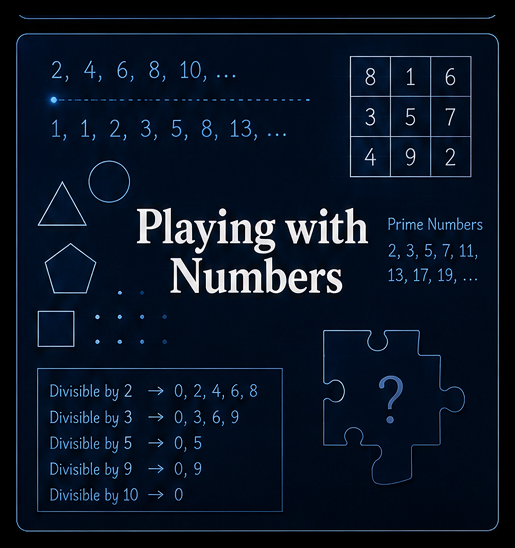
A number is divisible by 2 if its ones digit is 0, 2, 4, 6, or 8. Since only the last digit determines whether a number is even, the remaining digits do not affect divisibility by 2.
A number is divisible by 5 if its ones digit is 0 or 5. Again, only the units digit matters because every multiple of 10 is already divisible by 5.
For divisibility by 3 and 9, the sum of all the digits is considered. If the sum of the digits is divisible by 3, then the number itself is divisible by 3. Likewise, if the digit sum is divisible by 9, then the entire number is divisible by 9. These simple tests allow students to identify multiples quickly without lengthy calculations.
Cryptarithms and Letter Puzzles
Cryptarithms are mathematical puzzles in which letters are used instead of digits. The objective is to determine which digit each letter represents while satisfying the given arithmetic operation.
Two important rules must always be remembered. Every letter represents only one unique digit, and the first digit of any number cannot be zero because numbers do not begin with zero.
Looking at the units column, A + 3 = 5, so A = 2.
Next, in the tens column, 1 + B = 8, giving B = 7.
By solving one column at a time, students can determine the missing digits using logical reasoning instead of guessing randomly.
Solving Multiplication Puzzles
Some cryptarithms involve multiplication instead of addition. In such questions, students carefully examine the multiplication process, carry values, and the units digit to determine the correct value of each letter.
Logical elimination plays an important role in solving these puzzles. Each possible digit is tested against the given conditions until the correct solution is found. These activities improve observation skills, logical thinking, and confidence in mathematical reasoning.
Importance of Playing with Numbers
The concepts in this chapter are useful beyond classroom mathematics. Divisibility tests simplify calculations and help students solve problems more efficiently. The generalized form of numbers develops an understanding of algebraic thinking, while cryptarithms encourage logical reasoning and analytical skills.
These ideas prepare students for advanced topics in algebra and number theory and make mathematics more interesting by showing that numbers follow beautiful and predictable patterns.
Practice Questions
- Write the generalized form of the three-digit number abc.
- Is 936 divisible by 9? Give a reason.
- Explain why the sum of a two-digit number and its reverse is always divisible by 11.
- What are the two important rules for solving cryptarithms?
- Is 745 divisible by 5? Explain your answer.
Answer Key
ANSWER 1
The generalized form is 100a + 10b + c, where a, b, and c represent the hundreds, tens, and ones digits respectively.
ANSWER 2
Yes. The sum of the digits is 9 + 3 + 6 = 18, and 18 is divisible by 9, so 936 is divisible by 9.
ANSWER 3
If ab = 10a + b and ba = 10b + a, then their sum is 11(a + b), which is always divisible by 11.
ANSWER 4
Each letter represents only one unique digit, and the first digit of a number cannot be zero.
ANSWER 5
Yes. The ones digit of 745 is 5, so it is divisible by 5.
संख्याओं से खेलना
सीखने के उद्देश्य
संख्याओं के व्यापक रूप को समझना, स्थानीय मानों की सहायता से संख्याओं को व्यक्त करना, अंकों को उलटने पर बनने वाले रोचक गणितीय संबंधों का अध्ययन करना, विभाज्यता के नियमों के पीछे के गणितीय तर्क को समझना तथा क्रिप्टअरिथ्म जैसी गणितीय पहेलियों को तार्किक ढंग से हल करना सीखना।
परिचय
गणित में संख्याएँ केवल गिनती करने का माध्यम नहीं हैं, बल्कि इनके भीतर अनेक रोचक नियम, प्रतिरूप और संबंध छिपे होते हैं। इस अध्याय में विद्यार्थी सीखते हैं कि किसी भी संख्या को उसके अंकों और उनके स्थानीय मानों की सहायता से व्यापक रूप में कैसे लिखा जाता है। यही अवधारणा आगे चलकर बीजगणित तथा संख्या पद्धति को समझने में अत्यंत उपयोगी सिद्ध होती है।
इस अध्याय में विभाज्यता के नियमों के पीछे छिपे तर्क को भी समझाया गया है। विद्यार्थी केवल नियम याद नहीं करते, बल्कि यह भी जानते हैं कि वे नियम सही क्यों हैं। इसके साथ ही क्रिप्टअरिथ्म जैसी रोचक गणितीय पहेलियों के माध्यम से तार्किक सोच, विश्लेषण करने की क्षमता तथा समस्या समाधान कौशल का विकास होता है।
संख्याओं का व्यापक रूप
प्रत्येक संख्या विभिन्न अंकों से मिलकर बनी होती है और प्रत्येक अंक का अपना एक स्थानीय मान होता है। किसी संख्या को उसके स्थानीय मानों के आधार पर लिखना उसका व्यापक रूप (Generalised Form) कहलाता है।
यदि कोई दो अंकों की संख्या ab है, जहाँ a दहाई का अंक तथा b इकाई का अंक है, तो उसे इस प्रकार लिखा जाता है—
ab = 10a + b
इसी प्रकार यदि कोई तीन अंकों की संख्या abc है, तो उसका व्यापक रूप होगा—
abc = 100a + 10b + c
इस प्रकार किसी संख्या को स्थानीय मानों के आधार पर व्यक्त करने से उसकी संरचना स्पष्ट रूप से समझ में आती है। यही विधि आगे चलकर विभाज्यता के नियमों तथा अनेक गणितीय प्रमाणों को समझने में सहायता करती है।
अंकों को उलटने पर बनने वाले प्रतिरूप
व्यापक रूप का उपयोग करके संख्याओं के कई रोचक गुणों को समझा जा सकता है। यदि ab किसी दो अंकों की संख्या है, तो उसके अंकों को उलटने पर संख्या ba बनती है।
यदि इन दोनों संख्याओं को जोड़ा जाए,
ab + ba = 11(a + b)
अर्थात दोनों संख्याओं का योग सदैव 11 से विभाजित होता है।
इसी प्रकार यदि बड़ी संख्या में से छोटी संख्या घटाई जाए,
ab − ba = 9(a − b)
तो अंतर सदैव 9 से विभाजित होता है।
ये परिणाम यह सिद्ध करते हैं कि गणित में अनेक नियम केवल संयोग नहीं होते, बल्कि उनके पीछे स्पष्ट बीजगणितीय तर्क होता है। इस प्रकार के प्रतिरूप विद्यार्थियों में गणित के प्रति रुचि और जिज्ञासा उत्पन्न करते हैं।
विभाज्यता के नियम
विभाज्यता के नियम बड़ी संख्याओं की जाँच करने का सरल और तेज़ तरीका प्रदान करते हैं। इन नियमों की सहायता से बिना पूरी भाग देने की प्रक्रिया किए यह ज्ञात किया जा सकता है कि कोई संख्या किसी दूसरी संख्या से पूर्णतः विभाजित होगी या नहीं।
यदि किसी संख्या का अंतिम अंक 0, 2, 4, 6 या 8 हो, तो वह संख्या 2 से विभाजित होती है क्योंकि केवल इकाई का अंक ही सम या विषम होने का निर्धारण करता है।
यदि किसी संख्या का अंतिम अंक 0 या 5 हो, तो वह संख्या 5 से विभाजित होती है।
3 तथा 9 से विभाज्यता ज्ञात करने के लिए संख्या के सभी अंकों का योग किया जाता है। यदि अंकों का योग 3 से विभाजित होता है, तो पूरी संख्या भी 3 से विभाजित होगी। इसी प्रकार यदि अंकों का योग 9 से विभाजित होता है, तो संख्या भी 9 से विभाजित होगी।
इन नियमों का प्रयोग प्रतियोगी परीक्षाओं, मानसिक गणना तथा दैनिक जीवन की अनेक गणनाओं में किया जाता है।
क्रिप्टअरिथ्म और अक्षर पहेलियाँ
क्रिप्टअरिथ्म ऐसी गणितीय पहेलियाँ होती हैं जिनमें अंकों के स्थान पर अक्षरों का प्रयोग किया जाता है। इन पहेलियों का उद्देश्य प्रत्येक अक्षर का सही अंक ज्ञात करना होता है ताकि दिया गया जोड़, घटाव या गुणा सही सिद्ध हो सके।
ऐसी पहेलियों को हल करते समय दो महत्वपूर्ण नियमों का पालन करना आवश्यक होता है। पहला, प्रत्येक अक्षर केवल एक ही अंक का प्रतिनिधित्व करता है। दूसरा, किसी भी बहु-अंकीय संख्या का पहला अंक 0 नहीं हो सकता।
उदाहरण के लिए यदि किसी जोड़ में इकाई वाले स्थान पर A + 3 = 5 हो, तो तुरंत ज्ञात हो जाता है कि A = 2 होगा। इसी प्रकार दहाई वाले स्थान की सहायता से दूसरे अक्षर का मान निकाला जा सकता है। इस प्रकार विद्यार्थी क्रमबद्ध ढंग से पूरे प्रश्न का समाधान करते हैं।
गुणा संबंधी अक्षर पहेलियाँ
कुछ क्रिप्टअरिथ्म प्रश्न जोड़ के बजाय गुणा पर आधारित होते हैं। ऐसे प्रश्नों में विद्यार्थियों को इकाई अंक, कैरी तथा गुणा की प्रक्रिया का ध्यान रखते हुए प्रत्येक अक्षर का सही मान ज्ञात करना होता है।
इन पहेलियों को हल करने के लिए तार्किक सोच, परीक्षण विधि तथा गलत संभावनाओं को क्रमशः हटाने की रणनीति अपनाई जाती है। इस प्रकार के अभ्यास विद्यार्थियों की विश्लेषणात्मक क्षमता तथा आत्मविश्वास दोनों को बढ़ाते हैं।
संख्याओं से खेलना का महत्व
इस अध्याय में सीखी गई अवधारणाएँ केवल पाठ्यपुस्तक तक सीमित नहीं हैं। विभाज्यता के नियम बड़ी संख्याओं की शीघ्र जाँच करने में सहायता करते हैं। व्यापक रूप विद्यार्थियों में बीजगणितीय सोच विकसित करता है, जबकि क्रिप्टअरिथ्म तार्किक निर्णय लेने और समस्या समाधान की क्षमता को मजबूत बनाते हैं।
ये सभी विषय आगे चलकर बीजगणित, संख्या सिद्धांत तथा उच्च गणित के अध्ययन के लिए मजबूत आधार तैयार करते हैं। साथ ही यह अध्याय विद्यार्थियों को यह अनुभव कराता है कि गणित केवल गणना का विषय नहीं, बल्कि तर्क और पैटर्न को समझने की एक रोचक प्रक्रिया है।
अभ्यास प्रश्न
- तीन अंकों की संख्या abc का व्यापक रूप लिखिए।
- क्या 936, 9 से विभाजित होती है? कारण सहित बताइए।
- सिद्ध कीजिए कि किसी दो अंकों की संख्या और उसके उल्टे रूप का योग सदैव 11 से विभाजित होता है।
- क्रिप्टअरिथ्म हल करते समय पालन किए जाने वाले दो मुख्य नियम लिखिए।
- क्या 745, 5 से विभाजित होती है? कारण सहित उत्तर दीजिए।
उत्तर
उत्तर 1
तीन अंकों की संख्या abc का व्यापक रूप 100a + 10b + c होता है, जहाँ a, b तथा c क्रमशः सैकड़ा, दहाई और इकाई के अंक हैं।
उत्तर 2
हाँ। 936 के अंकों का योग 9 + 3 + 6 = 18 है और 18, 9 से विभाजित होता है। इसलिए 936 भी 9 से विभाजित होती है।
उत्तर 3
यदि ab = 10a + b तथा ba = 10b + a हो, तो उनका योग 11(a + b) होगा। इसलिए यह सदैव 11 से विभाजित होता है।
उत्तर 4
प्रत्येक अक्षर केवल एक ही अंक का प्रतिनिधित्व करता है तथा किसी भी संख्या का पहला अंक 0 नहीं हो सकता।
उत्तर 5
हाँ। 745 का अंतिम अंक 5 है। इसलिए यह 5 से पूर्णतः विभाजित होती है।