
CHAPTER 5
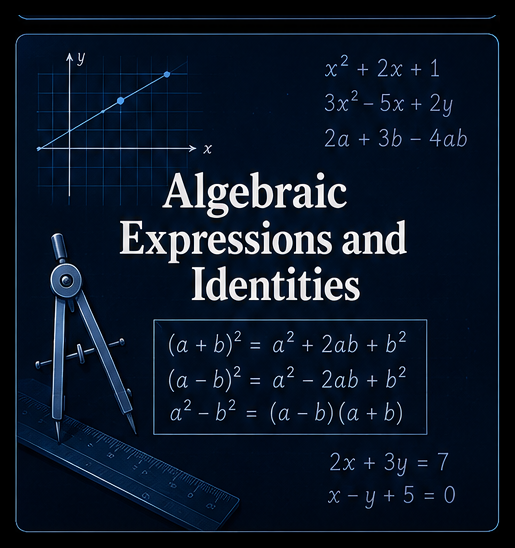
Algebraic Expressions and Identities
Learn Algebraic Expressions and Identities through interactive video lessons covering variables, algebraic expressions, addition, subtraction, multiplication of polynomials, and standard algebraic identities with easy examples.
बीजीय व्यंजक एवं सर्वसमिकाएँ अध्याय को सरल वीडियो पाठों के माध्यम से सीखें। चर, बीजीय व्यंजक, जोड़, घटाव, बहुपदों का गुणा तथा महत्वपूर्ण सर्वसमिकाओं का प्रयोग आसान उदाहरणों सहित समझें।
VIDEOS
Learn Algebraic Expressions and Identities through interactive video lessons covering algebraic terms, like and unlike terms, addition and subtraction of expressions, multiplication of monomials and polynomials, and standard algebraic identities with simple examples and shortcut techniques for solving problems.
भाग 1: बीजीय व्यंजकों का परिचय
इस वीडियो में बीजीय व्यंजकों की मूल अवधारणाओं को समझाया गया है। विद्यार्थी चर, अचर, गुणांक तथा पदों की पहचान करना सीखते हैं। साथ ही एकपदी, द्विपदी एवं त्रिपदी व्यंजकों का परिचय तथा समान पदों की सहायता से जोड़ और घटाव करना भी समझाया गया है।
Part 1: Introduction to Algebraic Expressions
This video introduces the basic concepts of algebraic expressions, including variables, constants, coefficients, and terms. Students learn different types of algebraic expressions and understand how to perform addition and subtraction by combining like terms.
भाग 2: बीजीय व्यंजकों का गुणा
इस पाठ में एकपदी और बहुपदों के गुणा की विधि को सरल उदाहरणों द्वारा समझाया गया है। विद्यार्थी वितरण नियम का प्रयोग करना, घातांकों के नियमों को लागू करना तथा व्यंजकों को व्यवस्थित रूप से सरल बनाना सीखते हैं।
Part 2: Multiplication of Algebraic Expressions
This lesson explains how to multiply monomials and polynomials using the distributive property. Students learn to simplify expressions by applying exponent rules and multiplying each term systematically.
भाग 3: बहुपदों का गुणा
इस वीडियो में दो द्विपदों का गुणा चरणबद्ध तरीके से समझाया गया है। विद्यार्थी प्रत्येक पद का गुणा करना, प्राप्त पदों को व्यवस्थित करना तथा समान पदों को मिलाकर अंतिम उत्तर प्राप्त करना सीखते हैं।
Part 3: Multiplication of Polynomials
This video demonstrates how to multiply two binomials step by step. Students learn to expand polynomial expressions, perform cross multiplication correctly, and simplify the final answer by combining like terms.
भाग 4: सर्वसमिकाएँ
इस पाठ में महत्वपूर्ण बीजीय सर्वसमिकाओं का परिचय दिया गया है। विद्यार्थी विभिन्न सर्वसमिकाओं का उपयोग करके व्यंजकों का विस्तार करना, मानसिक गणनाएँ करना तथा कठिन प्रश्नों को सरल और तेज़ी से हल करना सीखते हैं.
Part 4: Algebraic Identities
This lesson introduces the concept of algebraic identities and explains the most important standard identities used in mathematics. Students learn how these identities simplify calculations, expand expressions, and solve numerical problems quickly through practical examples.
Algebraic Expressions and Identities
Learning Objectives
Understand the structure of algebraic expressions and identify variables, constants, coefficients, and terms. Learn to perform addition, subtraction, and multiplication of algebraic expressions, simplify polynomial expressions, and apply standard algebraic identities to solve mathematical problems quickly and accurately.
Introduction to Algebraic Expressions and Identities
Algebra is one of the most important branches of mathematics because it allows us to represent numbers, relationships, and real-life situations using symbols and variables. Instead of working only with known numbers, algebra uses letters such as x, y, and z to represent unknown quantities. These letters help us solve equations, recognize patterns, and build mathematical models used in science, engineering, economics, and technology.
An algebraic expression is formed by combining variables, constants, and mathematical operations. Understanding how to simplify and manipulate these expressions is essential before learning equations, factorization, and higher algebra. This chapter also introduces algebraic identities, which are useful formulas that simplify lengthy calculations and improve problem-solving speed.
Basic Terms in Algebraic Expressions
An algebraic expression consists of different parts that work together to represent a mathematical quantity. A variable is a symbol, usually a letter, whose value may change depending on the situation. Common variables include x, y, and z. A constant is a fixed numerical value that never changes, such as 5, −3, or 12.
Every algebraic expression is made up of one or more terms. A term is formed by multiplying constants and variables together. The numerical part of a term is called its coefficient. For example, in the term 7x², the coefficient is 7, while x² is the variable part.
Algebraic expressions are classified according to the number of terms they contain. An expression with one term is called a monomial, such as 4x². An expression containing two terms is called a binomial, such as 3x + 5. An expression containing three terms is called a trinomial, such as x² + 2x + 1. Expressions containing more than three terms are simply called polynomials.
Understanding these basic terms helps students identify the structure of expressions and perform algebraic operations correctly.
Addition and Subtraction of Algebraic Expressions
Addition and subtraction of algebraic expressions follow a simple but important rule: only like terms can be added or subtracted. Like terms have exactly the same variables raised to the same powers. Their numerical coefficients may differ, but the variable parts must be identical.
For example,
2x² + 5x² = 7x²
because both terms contain x².
Similarly,
8xy − 3xy = 5xy
However,
4x and 4y are unlike terms because their variables are different. Likewise,
3x and 3x² are unlike because the powers of the variables are different.
When adding or subtracting complete expressions, students first remove brackets wherever necessary and then combine all like terms carefully.
For example,
(2x² + 3x) + (5x² − x)
becomes
7x² + 2x.
Simplifying expressions by combining like terms is one of the most fundamental skills in algebra and is used throughout higher mathematics.
Multiplication of Algebraic Expressions
Multiplication of algebraic expressions begins with multiplying monomials. The numerical coefficients are multiplied together, while variables having the same base are combined using the laws of exponents.
For example,
(3x)(−5xy) = −15x²y.
When multiplying a monomial by a polynomial, the Distributive Property is applied. Every term inside the bracket must be multiplied by the outside term.
For example,
2x(3x + y)
becomes
6x² + 2xy.
The distributive property makes multiplication easier and forms the basis for multiplying larger algebraic expressions.
When multiplying two polynomials, each term of the first polynomial is multiplied by every term of the second polynomial. After multiplication, all like terms are combined to obtain the simplest possible expression.
For example,
(x + 2)(x + 5)
becomes
x² + 5x + 2x + 10
which simplifies to
x² + 7x + 10.
Carefully organizing the multiplication process helps avoid mistakes and ensures accurate simplification.
Algebraic Identities
An algebraic identity is a mathematical statement that remains true for every possible value of its variables. Unlike ordinary equations, identities do not have specific solutions because they are always valid.
Algebraic identities make calculations faster and help simplify lengthy expressions without repeated multiplication.
Some of the most important identities are:
(a + b)² = a² + 2ab + b²
(a − b)² = a² − 2ab + b²
(a + b)(a − b) = a² − b²
(x + a)(x + b) = x² + (a + b)x + ab
These identities are frequently used to expand expressions, factorize polynomials, verify equations, and perform mental calculations.
For example,
103²
can be written as
(100 + 3)²
Applying the identity,
100² + 2(100)(3) + 3²
= 10000 + 600 + 9
= 10609.
Using identities saves time and reduces the amount of manual multiplication required.
Applications of Algebraic Expressions and Identities
Algebraic expressions are used in almost every field involving mathematics. Engineers use them while designing structures, scientists use them to describe physical laws, economists use them to represent financial models, and computer programmers use algebraic formulas while developing algorithms.
Algebraic identities help simplify calculations in geometry, trigonometry, coordinate geometry, and advanced algebra. Developing confidence with these concepts prepares students for quadratic equations, factorization, and higher-level mathematics in future classes.
Practice Questions
- Identify the coefficient and variable in 9x².
- Simplify (4x + 3x − 2x).
- Multiply 3x(2x + 5).
- Multiply (x + 4)(x + 2).
- Expand (a + b)² using the standard identity.
Answer Key
ANSWER 1
In 9x², the coefficient is 9 and the variable part is x².
ANSWER 2
4x + 3x − 2x = 5x.
ANSWER 3
3x(2x + 5) = 6x² + 15x.
ANSWER 4
(x + 4)(x + 2) = x² + 6x + 8.
ANSWER 5
(a + b)² = a² + 2ab + b².
बीजीय व्यंजक एवं सर्वसमिकाएँ
सीखने के उद्देश्य
बीजीय व्यंजकों की संरचना को समझना तथा चर, अचर, गुणांक और पदों की पहचान करना। बीजीय व्यंजकों का जोड़, घटाव और गुणा करना सीखना, बहुपदों को सरल बनाना तथा सर्वसमिकाओं का उपयोग करके गणनाओं को तेज़ और सरल बनाना।
बीजीय व्यंजकों एवं सर्वसमिकाओं का परिचय
बीजगणित गणित की एक महत्वपूर्ण शाखा है जिसमें अज्ञात राशियों को व्यक्त करने के लिए अक्षरों और प्रतीकों का उपयोग किया जाता है। संख्याओं के स्थान पर x, y तथा z जैसे अक्षरों का प्रयोग करके विभिन्न समस्याओं का समाधान किया जाता है। यही कारण है कि बीजगणित का उपयोग विज्ञान, अभियांत्रिकी, कंप्यूटर विज्ञान, अर्थशास्त्र तथा दैनिक जीवन की अनेक समस्याओं में किया जाता है।
बीजीय व्यंजक चर, अचर तथा गणितीय संक्रियाओं से मिलकर बनते हैं। इन व्यंजकों को जोड़ना, घटाना, गुणा करना तथा सरल बनाना बीजगणित की आधारभूत कौशल है। इस अध्याय में सर्वसमिकाओं का भी अध्ययन किया जाता है, जिनकी सहायता से कठिन गणनाओं को बहुत कम समय में हल किया जा सकता है।
बीजीय व्यंजकों के मूल घटक
बीजीय व्यंजक कई भागों से मिलकर बनता है। चर (Variable) वह प्रतीक है जिसका मान बदल सकता है, जैसे x, y, z। अचर (Constant) वह निश्चित संख्या होती है जिसका मान कभी नहीं बदलता, जैसे 5, −3 या 12।
बीजीय व्यंजक का प्रत्येक भाग पद (Term) कहलाता है। किसी पद में उपस्थित संख्यात्मक भाग को गुणांक (Coefficient) कहा जाता है। उदाहरण के लिए, 7x² में 7 गुणांक है तथा x² चर भाग है।
पदों की संख्या के आधार पर व्यंजकों को वर्गीकृत किया जाता है। एक पद वाला व्यंजक एकपदी, दो पदों वाला द्विपदी, तीन पदों वाला त्रिपदी तथा तीन से अधिक पदों वाले व्यंजक बहुपद कहलाते हैं।
इन मूल अवधारणाओं की समझ बीजगणित के सभी आगामी अध्यायों के लिए अत्यंत आवश्यक है।
बीजीय व्यंजकों का जोड़ एवं घटाव
बीजीय व्यंजकों का जोड़ और घटाव केवल समान पदों के बीच ही किया जा सकता है। समान पद वे होते हैं जिनमें चर तथा उनके घात समान हों। केवल उनके गुणांक अलग हो सकते हैं।
उदाहरण के लिए,
2x² + 5x² = 7x²
क्योंकि दोनों पदों में x² समान है।
इसी प्रकार,
8xy − 3xy = 5xy।
लेकिन,
4x और 4y समान पद नहीं हैं क्योंकि उनके चर अलग हैं। इसी प्रकार 3x तथा 3x² भी असमान पद हैं क्योंकि उनके घात अलग हैं।
दो या अधिक व्यंजकों का जोड़ या घटाव करते समय पहले कोष्ठकों को हटाया जाता है और फिर समान पदों को मिलाकर अंतिम उत्तर प्राप्त किया जाता है।
उदाहरण,
(2x² + 3x) + (5x² − x)
= 7x² + 2x।
बीजीय व्यंजकों का गुणा
बीजीय व्यंजकों के गुणा में सबसे पहले गुणांकों का गुणा किया जाता है और समान आधार वाले चरों के घातों को जोड़ दिया जाता है।
उदाहरण,
(3x)(−5xy) = −15x²y।
जब किसी एकपदी का गुणा किसी बहुपद से किया जाता है, तब वितरण नियम (Distributive Property) का प्रयोग किया जाता है। बाहरी पद को कोष्ठक के प्रत्येक पद से गुणा किया जाता है।
उदाहरण,
2x(3x + y)
= 6x² + 2xy।
दो बहुपदों का गुणा करते समय पहले बहुपद का प्रत्येक पद दूसरे बहुपद के प्रत्येक पद से गुणा किया जाता है। इसके बाद प्राप्त समान पदों को जोड़कर अंतिम व्यंजक को सरल बनाया जाता है।
उदाहरण,
(x + 4)(x + 2)
= x² + 4x + 2x + 8
= x² + 6x + 8।
सर्वसमिकाएँ
सर्वसमिका वह बीजीय समानता है जो चरों के प्रत्येक मान के लिए सदैव सत्य रहती है। यह सामान्य समीकरण से भिन्न होती है क्योंकि समीकरण केवल कुछ विशेष मानों के लिए सत्य होता है।
महत्वपूर्ण सर्वसमिकाएँ हैं—
(a + b)² = a² + 2ab + b²
(a − b)² = a² − 2ab + b²
(a + b)(a − b) = a² − b²
(x + a)(x + b) = x² + (a + b)x + ab
इन सर्वसमिकाओं का उपयोग व्यंजकों के विस्तार, गुणनखंड, मानसिक गणना तथा कठिन प्रश्नों को सरल बनाने में किया जाता है।
उदाहरण के लिए,
103² = (100 + 3)²
= 100² + 2(100)(3) + 3²
= 10000 + 600 + 9
= 10609।
सर्वसमिकाओं का नियमित अभ्यास विद्यार्थियों की गणना की गति और शुद्धता दोनों को बढ़ाता है।
बीजीय व्यंजकों एवं सर्वसमिकाओं का महत्व
बीजीय व्यंजकों का उपयोग विज्ञान, अभियांत्रिकी, कंप्यूटर प्रोग्रामिंग, वास्तुकला, वित्त तथा सांख्यिकी सहित अनेक क्षेत्रों में किया जाता है। सर्वसमिकाएँ गणनाओं को सरल बनाती हैं और आगे चलकर बहुपद, गुणनखंड, द्विघात समीकरण तथा उच्च बीजगणित के अध्ययन की मजबूत नींव तैयार करती हैं।
अभ्यास प्रश्न
- 9x² में गुणांक तथा चर ज्ञात कीजिए।
- 4x + 3x − 2x को सरल कीजिए।
- 3x(2x + 5) का गुणा कीजिए।
- (x + 4)(x + 2) का विस्तार कीजिए।
- (a + b)² का विस्तार लिखिए।
उत्तर
उत्तर 1
9x² में गुणांक 9 तथा चर भाग x² है।
उत्तर 2
4x + 3x − 2x = 5x।
उत्तर 3
3x(2x + 5) = 6x² + 15x।
उत्तर 4
(x + 4)(x + 2) = x² + 6x + 8।
उत्तर 5
(a + b)² = a² + 2ab + b²।