
Chapter 5
गणितीय आगमन का सिद्धांत
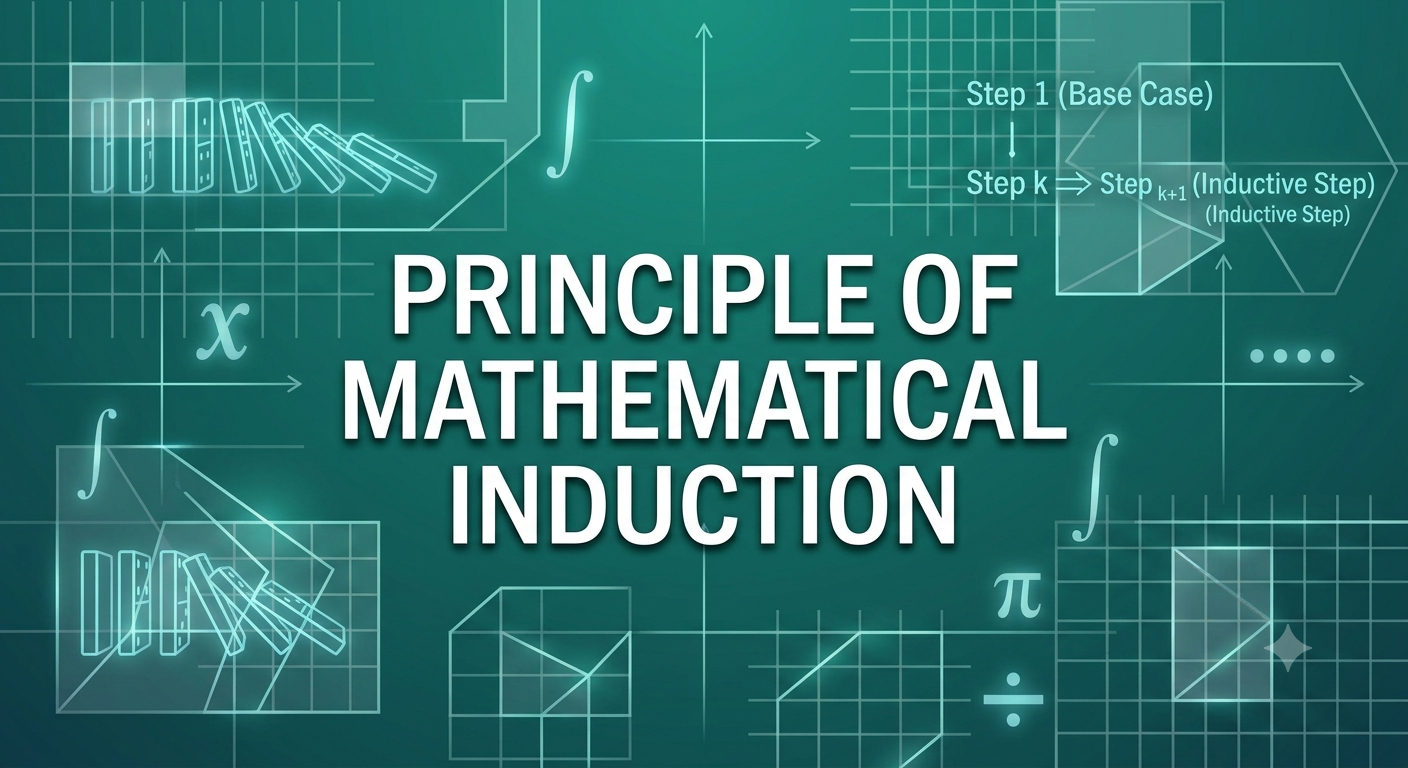
Principle of Mathematical Induction
इस अध्याय में आप आगमन के सिद्धांत को समझेंगे तथा इसकी सहायता से विभिन्न सूत्रों और सर्वसमिकाओं को सिद्ध करना सीखेंगे। यह अध्याय तार्किक एवं प्रमाणात्मक सोच को सुदृढ़ बनाता है।
In this chapter, you will learn the principle of induction and apply it to prove various formulas and identities with confidence and accuracy.
VIDEOS
Principle of Mathematical Induction: Part 1
गणितीय आगमन के सिद्धांत की मूल अवधारणा का परिचय, इसकी तर्कशक्ति, तीन-चरणीय प्रक्रिया (P(1), P(k), और P(k+1)) और गणितीय कथनों को सिद्ध करने में इसके उपयोग की व्याख्या।
Introduces the fundamental concept of the Principle of Mathematical Induction, explaining its logic, the three-step process (P(1), P(k), and P(k+1)), and its use in proving mathematical statements.
Principle of Mathematical Induction: Part 2
गणितीय आगमन के सिद्धांत का उपयोग करते हुए अधिक जटिल गणितीय समस्याओं और असमिकाओं (inequalities) को हल करने पर ध्यान केंद्रित, जो भाग 1 में सीखे गए चरणों को सुदृढ़ करता है।
Focuses on solving more complex mathematical problems and inequalities using the Principle of Mathematical Induction, reinforcing the steps learned in Part 1.
NOTES
Principle of Mathematical Induction
Introduction
The Principle of Mathematical Induction (PMI) is a mathematical technique used to prove statements that are true for all natural numbers. Instead of checking each value individually, mathematical induction proves that if a statement is true for the first natural number and remains true for the next number, then it is true for all natural numbers.
Mathematical Induction
What is Mathematical Induction?
Mathematical induction is a method of proof used to verify statements involving natural numbers.
It is based on the idea that if the first step is correct and each step leads to the next, then the entire sequence of steps is correct.
Principle of Mathematical Induction
Statement of the Principle
Let P(n) be a statement involving a natural number n.
To prove that P(n) is true for all natural numbers, two steps are followed:
- Base Case: Show that P(1) (or the first given value) is true.
- Induction Step: Assume P(k) is true for some natural number k, then prove that P(k + 1) is also true.
If both steps are satisfied, then P(n) is true for all natural numbers.
Steps of Mathematical Induction
Procedure
The process of mathematical induction consists of:
- Writing the given statement P(n).
- Verifying the base case.
- Assuming P(k) is true (Induction Hypothesis).
- Proving P(k + 1) using the assumption.
- Concluding that the statement is true for all natural numbers.
Induction Hypothesis
Assumption in the Proof
The assumption that P(k) is true for some natural number k is called the Induction Hypothesis.
This assumption is used only to prove the next case, P(k + 1).
Applications of Mathematical Induction
Where is it Used?
Mathematical induction is commonly used to prove:
- Algebraic identities.
- Formulae involving sums.
- Divisibility properties.
- Inequalities.
- Statements involving natural numbers.
- Recursive relations.
Advantages of Mathematical Induction
Importance
Mathematical induction:
- Proves infinitely many cases using only two steps.
- Saves time and effort.
- Provides a logical and systematic method of proof.
- Is widely used in higher mathematics and computer science.
Important Points
Remember
- Always verify the base case first.
- The induction hypothesis should not be treated as the final proof.
- The proof is complete only after proving P(k + 1).
- Mathematical induction is applicable only to statements involving natural numbers.
Key Points
- Mathematical induction proves statements for all natural numbers.
- The proof consists of the base case and the induction step.
- The assumption P(k) is called the induction hypothesis.
- If both steps are satisfied, the statement is true for every natural number.
- PMI is widely used in algebra, number theory, and higher mathematics.
Chapter Summary
The Principle of Mathematical Induction is an important proof technique used to establish the truth of mathematical statements involving natural numbers. The method involves verifying the first case and then proving that if the statement is true for one natural number, it is also true for the next. This principle provides a simple and powerful way to prove results that hold for infinitely many natural numbers.
गणितीय आगमन का सिद्धांत (Principle of Mathematical Induction)
परिचय
गणितीय आगमन का सिद्धांत (PMI) एक महत्वपूर्ण प्रमाण विधि है जिसका उपयोग प्राकृतिक संख्याओं से संबंधित कथनों को सिद्ध करने के लिए किया जाता है। प्रत्येक संख्या की अलग-अलग जाँच करने के बजाय, यह सिद्धांत यह प्रमाणित करता है कि यदि कथन पहली संख्या के लिए सत्य है तथा एक संख्या के लिए सत्य होने पर अगली संख्या के लिए भी सत्य है, तो वह कथन सभी प्राकृतिक संख्याओं के लिए सत्य होगा।
गणितीय आगमन
गणितीय आगमन क्या है?
गणितीय आगमन प्राकृतिक संख्याओं से संबंधित कथनों को सिद्ध करने की एक प्रमाण विधि है।
यह इस विचार पर आधारित है कि यदि पहली सीढ़ी सही हो और प्रत्येक सीढ़ी अगली सीढ़ी तक पहुँचाती हो, तो पूरी सीढ़ी सही होगी।
गणितीय आगमन का सिद्धांत
सिद्धांत का कथन
मान लीजिए P(n) प्राकृतिक संख्या n पर आधारित कोई कथन है।
किसी कथन को सभी प्राकृतिक संख्याओं के लिए सिद्ध करने हेतु निम्न दो चरण अपनाए जाते हैं—
- आधार चरण (Base Case): यह सिद्ध करें कि P(1) (या प्रश्न में दी गई पहली संख्या) सत्य है।
- आगमन चरण (Induction Step): मान लें कि P(k) किसी प्राकृतिक संख्या k के लिए सत्य है, फिर सिद्ध करें कि P(k + 1) भी सत्य है।
यदि दोनों चरण पूरे हो जाते हैं, तो P(n) सभी प्राकृतिक संख्याओं के लिए सत्य माना जाता है।
गणितीय आगमन की प्रक्रिया
Steps of Proof
गणितीय आगमन में निम्नलिखित चरण होते हैं—
- कथन P(n) लिखना।
- आधार चरण की जाँच करना।
- P(k) को सत्य मानना (आगमन परिकल्पना)।
- P(k + 1) को सिद्ध करना।
- निष्कर्ष निकालना कि कथन सभी प्राकृतिक संख्याओं के लिए सत्य है।
आगमन परिकल्पना
Induction Hypothesis
किसी प्राकृतिक संख्या k के लिए P(k) को सत्य मानने की प्रक्रिया को आगमन परिकल्पना (Induction Hypothesis) कहते हैं।
इसका उपयोग केवल P(k + 1) को सिद्ध करने के लिए किया जाता है।
गणितीय आगमन के अनुप्रयोग
उपयोग
गणितीय आगमन का उपयोग—
- बीजीय सर्वसमिकाओं को सिद्ध करने में।
- योग संबंधी सूत्रों को सिद्ध करने में।
- विभाज्यता (Divisibility) सिद्ध करने में।
- असमिकाओं (Inequalities) को सिद्ध करने में।
- प्राकृतिक संख्याओं से संबंधित कथनों को सिद्ध करने में।
- पुनरावर्ती संबंधों (Recursive Relations) में।
गणितीय आगमन का महत्व
Advantages
गणितीय आगमन—
- अनंत कथनों को केवल दो चरणों में सिद्ध करता है।
- समय और प्रयास की बचत करता है।
- प्रमाण की सरल एवं तार्किक विधि प्रदान करता है।
- उच्च गणित तथा कंप्यूटर विज्ञान में व्यापक रूप से प्रयुक्त होता है।
महत्वपूर्ण बातें
Remember
- सबसे पहले आधार चरण अवश्य सिद्ध करें।
- P(k) को केवल मानकर चला जाता है, इसे अंतिम प्रमाण नहीं माना जाता।
- प्रमाण तभी पूरा होता है जब P(k + 1) सिद्ध हो जाए।
- यह विधि केवल प्राकृतिक संख्याओं से संबंधित कथनों पर लागू होती है।
मुख्य बिंदु
- गणितीय आगमन प्राकृतिक संख्याओं के लिए कथनों को सिद्ध करता है।
- इसमें दो मुख्य चरण होते हैं—आधार चरण और आगमन चरण।
- P(k) को सत्य मानने की प्रक्रिया आगमन परिकल्पना कहलाती है।
- यदि दोनों चरण सिद्ध हो जाएँ, तो कथन सभी प्राकृतिक संख्याओं के लिए सत्य होता है।
- यह विधि बीजगणित, संख्या सिद्धांत तथा उच्च गणित में अत्यंत महत्वपूर्ण है।
अध्याय सारांश
इस अध्याय में गणितीय आगमन के सिद्धांत का अध्ययन किया गया। यह एक शक्तिशाली प्रमाण विधि है जो प्राकृतिक संख्याओं से संबंधित कथनों को सिद्ध करने के लिए प्रयोग की जाती है। इसमें पहले आधार चरण सिद्ध किया जाता है और फिर यह दिखाया जाता है कि यदि कथन किसी संख्या के लिए सत्य है, तो अगली संख्या के लिए भी सत्य होगा। इस प्रकार यह सिद्ध होता है कि कथन सभी प्राकृतिक संख्याओं के लिए सत्य है।