
Chapter 6:
समिश्र संख्याएँ एवं द्विघात समीकरण
Complex Numbers and Quadratic Equations
यह अध्याय संख्या पद्धति का विस्तार करता है और उच्च गणित एवं अभियांत्रिकी में महत्वपूर्ण भूमिका निभाता है।
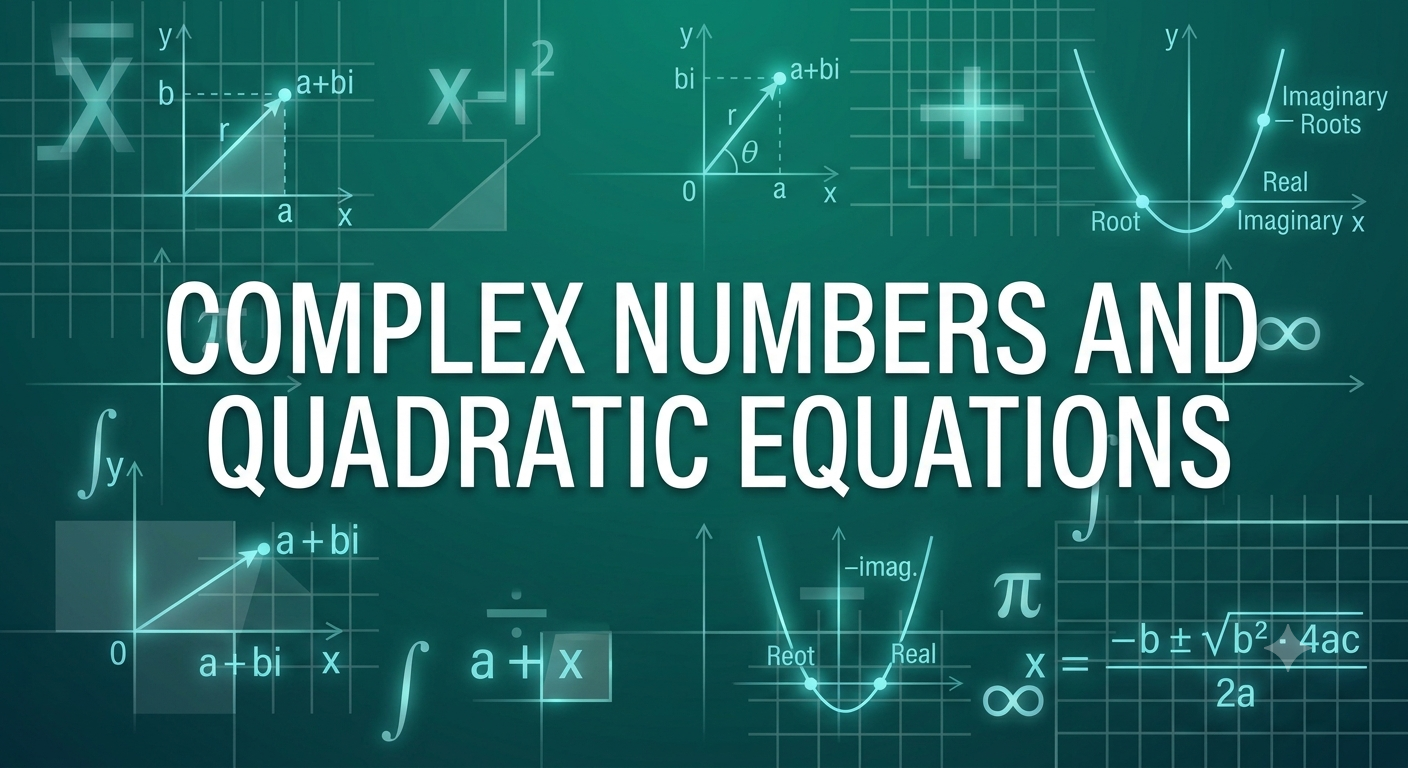
This chapter covers imaginary numbers, algebraic operations, and the solution of quadratic equations. These concepts extend the number system and play a vital role in higher mathematics and engineering.
VIDEOS
Complex Numbers and Quadratic Equations: Part 1
सम्मिश्र संख्याओं (a + ib) को परिभाषित करना, काल्पनिक इकाई $i$ की व्याख्या, और उन पर आधारभूत अंकगणितीय संक्रियाओं (जोड़, घटाव) का परिचय।
Defines complex numbers (a + ib), explains the imaginary unit $i$, and introduces the basic arithmetic operations (addition, subtraction) on them.
Complex Numbers and Quadratic Equations: Part 2
सम्मिश्र संख्याओं के गुणन, भाग, और उनके बीजगणितीय गुणों को कवर करना, जिसमें सम्मिश्र संख्या का संयुग्मी (conjugate) भी शामिल है।
Covers multiplication, division, and the algebraic properties of complex numbers, including the conjugate of a complex number.
Complex Numbers and Quadratic Equations: Part 3
सम्मिश्र संख्या का मापांक और कोणांक ज्ञात करना और आर्गंड तल (Argand plane) में उनका ज्यामितीय निरूपण।
Explains how to find the modulus (मापांक) and argument (कोणांक) of a complex number and their geometric representation in the Argand plane.
Complex Numbers and Quadratic Equations: Part 4
सम्मिश्र संख्याओं को ध्रुवीय रूप (r(cos a + isin a))में निरूपित करना और कार्तीय रूप से ध्रुवीय रूप में बदलना।
Focuses on representing complex numbers in polar form (r(cos a + isin a) and converting between Cartesian and polar forms.
Complex Numbers and Quadratic Equations: Part 5
वास्तविक गुणांकों वाले उन द्विघात समीकरणों को हल करना जिनके मूल सम्मिश्र (काल्पनिक) होते हैं, द्विघात सूत्र का उपयोग करके।
Discusses solving quadratic equations with real coefficients that have complex roots (negative discriminants), using the quadratic formula.
NOTES
Complex Numbers and Quadratic Equations
Introduction
The chapter Complex Numbers and Quadratic Equations extends the concept of real numbers by introducing imaginary and complex numbers. It also explains how quadratic equations can be solved even when they have no real roots. Complex numbers are widely used in mathematics, engineering, physics, and electrical sciences.
Complex Numbers
What is a Complex Number?
A complex number is a number of the form:
z = a + ib
where:
- a = Real Part (Re z)
- b = Imaginary Part (Im z)
- i = √−1, called the imaginary unit
Since √−1 is not a real number, i² = −1.
Types of Complex Numbers
Different Forms
Complex numbers are classified as:
- Purely Real Number: Imaginary part is zero. (Example: 5 + 0i)
- Purely Imaginary Number: Real part is zero. (Example: 4i)
- General Complex Number: Both real and imaginary parts are present. (Example: 3 + 2i)
- Zero Complex Number: Both real and imaginary parts are zero. (0 + 0i)
Equality of Complex Numbers
Condition for Equality
Two complex numbers are equal if:
- Their real parts are equal.
- Their imaginary parts are equal.
If:
a + ib = c + id
then,
- a = c
- b = d
Algebra of Complex Numbers
Basic Operations
Operations on complex numbers include:
- Addition
- Subtraction
- Multiplication
- Division
While multiplying complex numbers, use the identity:
i² = −1
Conjugate of a Complex Number
Complex Conjugate
The conjugate of
z = a + ib
is
z̄ = a − ib
Important properties:
- Product of a complex number and its conjugate is always a real number.
- Conjugates are useful in simplifying fractions involving complex numbers.
Modulus of a Complex Number
Magnitude
The modulus of
z = a + ib
is given by:
|z| = √(a² + b²)
The modulus represents the distance of the complex number from the origin on the Argand Plane.
Argand Plane
Geometrical Representation
A complex number is represented on the Argand Plane, where:
- Horizontal axis → Real Axis
- Vertical axis → Imaginary Axis
Each complex number corresponds to a unique point on the plane.
Quadratic Equations
Standard Form
A quadratic equation is written as:
ax² + bx + c = 0
where:
- a ≠ 0
- a, b, c are real numbers.
Solution of Quadratic Equations
Quadratic Formula
The roots of
ax² + bx + c = 0
are obtained using:
x = (-b ± √(b² − 4ac))/2a
The quantity b² − 4ac is called the Discriminant (D).
Nature of Roots
Discriminant
The discriminant determines the type of roots.
- D > 0: Two distinct real roots.
- D = 0: Two equal real roots.
- D < 0: Two complex (imaginary) roots.
Key Points
- A complex number is written as a + ib.
- i² = −1.
- Every complex number has a real part and an imaginary part.
- The conjugate changes only the sign of the imaginary part.
- The modulus gives the distance from the origin.
- The Argand Plane represents complex numbers graphically.
- A quadratic equation has the form ax² + bx + c = 0.
- The discriminant determines the nature of the roots.
Chapter Summary
This chapter introduces complex numbers, their algebra, conjugates, modulus, and graphical representation on the Argand Plane. It also explains quadratic equations and their solutions using the quadratic formula. The discriminant helps determine whether the roots are real or complex. These concepts are essential for higher mathematics, engineering, and physics.
समिश्र संख्याएँ एवं द्विघात समीकरण (Complex Numbers and Quadratic Equations)
परिचय
इस अध्याय में समिश्र संख्याओं (Complex Numbers) का परिचय दिया गया है, जो वास्तविक संख्याओं का विस्तार हैं। साथ ही, द्विघात समीकरणों (Quadratic Equations) के हल तथा उनके मूलों (Roots) की प्रकृति का अध्ययन किया जाता है। इनका उपयोग गणित, भौतिकी, इंजीनियरिंग तथा विद्युत विज्ञान में व्यापक रूप से होता है।
समिश्र संख्या
समिश्र संख्या क्या है?
समिश्र संख्या का सामान्य रूप है—
z = a + ib
जहाँ—
- a = वास्तविक भाग (Real Part)
- b = काल्पनिक भाग (Imaginary Part)
- i = √−1, जिसे काल्पनिक इकाई (Imaginary Unit) कहते हैं।
महत्वपूर्ण तथ्य:
i² = −1
समिश्र संख्याओं के प्रकार
मुख्य प्रकार
- शुद्ध वास्तविक संख्या: काल्पनिक भाग शून्य हो। (उदाहरण: 5 + 0i)
- शुद्ध काल्पनिक संख्या: वास्तविक भाग शून्य हो। (उदाहरण: 4i)
- सामान्य समिश्र संख्या: वास्तविक एवं काल्पनिक दोनों भाग हों। (उदाहरण: 3 + 2i)
- शून्य समिश्र संख्या: वास्तविक तथा काल्पनिक दोनों भाग शून्य हों।
समिश्र संख्याओं की समानता
समान होने की शर्त
यदि
a + ib = c + id
तो—
- a = c
- b = d
अर्थात दोनों संख्याओं के वास्तविक तथा काल्पनिक भाग समान होने चाहिए।
समिश्र संख्याओं पर संक्रियाएँ
Basic Operations
समिश्र संख्याओं पर निम्न संक्रियाएँ की जाती हैं—
- जोड़
- घटाव
- गुणा
- भाग
गुणा करते समय सदैव i² = −1 का प्रयोग किया जाता है।
समिश्र संख्या का संयुग्म
Conjugate
यदि
z = a + ib
तो इसका संयुग्म (Conjugate) होगा—
z̄ = a − ib
महत्वपूर्ण गुण—
- किसी समिश्र संख्या और उसके संयुग्म का गुणनफल सदैव वास्तविक संख्या होता है।
- संयुग्म का उपयोग भाग की संक्रिया को सरल बनाने में किया जाता है।
समिश्र संख्या का मापांक
Modulus
यदि
z = a + ib
तो उसका मापांक (Modulus) होगा—
|z| = √(a² + b²)
मापांक, मूल बिंदु से उस समिश्र संख्या की दूरी को दर्शाता है।
आर्गंड तल
Geometrical Representation
समिश्र संख्याओं को आर्गंड तल (Argand Plane) पर दर्शाया जाता है।
- क्षैतिज अक्ष → वास्तविक अक्ष
- ऊर्ध्वाधर अक्ष → काल्पनिक अक्ष
प्रत्येक समिश्र संख्या आर्गंड तल पर एक बिंदु द्वारा प्रदर्शित होती है।
द्विघात समीकरण
मानक रूप
द्विघात समीकरण का सामान्य रूप है—
ax² + bx + c = 0
जहाँ—
- a ≠ 0
- a, b, c वास्तविक संख्याएँ हैं।
द्विघात समीकरण का हल
Quadratic Formula
द्विघात समीकरण के मूल निम्न सूत्र से प्राप्त किए जाते हैं—
x = (-b ± √(b² − 4ac))/2a
यहाँ
D = b² − 4ac
को विभेदक (Discriminant) कहते हैं।
मूलों की प्रकृति
Nature of Roots
विभेदक के आधार पर—
- D > 0: दो भिन्न वास्तविक मूल।
- D = 0: दो समान वास्तविक मूल।
- D < 0: दो समिश्र (काल्पनिक) मूल।
मुख्य बिंदु
- समिश्र संख्या का रूप a + ib होता है।
- i² = −1।
- प्रत्येक समिश्र संख्या का वास्तविक तथा काल्पनिक भाग होता है।
- संयुग्म में केवल काल्पनिक भाग का चिन्ह बदलता है।
- मापांक मूल बिंदु से दूरी दर्शाता है।
- आर्गंड तल पर समिश्र संख्याओं का निरूपण किया जाता है।
- द्विघात समीकरण का सामान्य रूप ax² + bx + c = 0 है।
- विभेदक मूलों की प्रकृति निर्धारित करता है।
अध्याय सारांश
इस अध्याय में समिश्र संख्याओं की अवधारणा, उनके प्रकार, संयुग्म, मापांक तथा आर्गंड तल पर निरूपण का अध्ययन किया गया। साथ ही, द्विघात समीकरणों के हल के लिए द्विघात सूत्र तथा विभेदक के आधार पर मूलों की प्रकृति को समझाया गया। यह अध्याय उच्च गणित, इंजीनियरिंग तथा विज्ञान की आगे की पढ़ाई के लिए अत्यंत महत्वपूर्ण है।