
CHAPTER 4
EXPONENTS AND POWERS
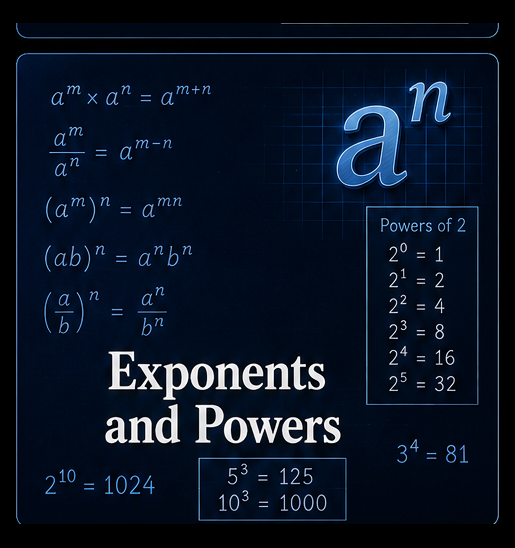
Learn Exponents and Powers through interactive video lessons covering exponents, laws of exponents, negative powers, zero exponents, and scientific notation for expressing very large and very small numbers.
घातांक और घात अध्याय को सरल वीडियो पाठों के माध्यम से सीखें। घातांक, घातों के नियम, ऋणात्मक एवं शून्य घातांक तथा बड़ी और छोटी संख्याओं को मानक रूप (Scientific Notation) में लिखना सरल उदाहरणों सहित समझें.
VIDEOS
Learn Exponents and Powers through interactive video lessons covering exponents, laws of exponents, negative and zero powers, and scientific notation for representing very large and very small numbers with ease.
भाग 1: घातांक और घात का परिचय
इस वीडियो में घातांक और घात की मूल अवधारणा को सरल उदाहरणों के माध्यम से समझाया गया है। विद्यार्थी आधार (Base), घातांक (Exponent) तथा बार-बार गुणा को घात के रूप में लिखना सीखते हैं। साथ ही ऋणात्मक घातांकों को व्युत्क्रम (Reciprocal) की सहायता से व्यक्त करने की विधि भी समझाई गई है।
Part 1: Introduction to Exponents and Powers
This video introduces the concept of exponents and powers by explaining repeated multiplication. Students learn the meaning of the base and exponent, understand exponential notation, and explore how negative exponents are represented using reciprocal values.
भाग 2: घातांकों के नियम
इस पाठ में घातांकों के सभी महत्वपूर्ण नियमों की विस्तार से व्याख्या की गई है। विद्यार्थी समान आधार वाली घातों का गुणा एवं भाग, घात की घात, समान घात वाले विभिन्न आधारों पर नियमों का प्रयोग तथा शून्य घातांक के नियम को सरल उदाहरणों द्वारा समझते हैं।
Part 2: Laws of Exponents
This lesson explains the fundamental laws of exponents used to simplify mathematical expressions. Students learn the rules for multiplying and dividing powers, raising a power to another power, working with common exponents, and applying the zero exponent rule through easy examples.
भाग 3: मानक रूप (Scientific Notation)
इस वीडियो में बहुत बड़ी और बहुत छोटी संख्याओं को मानक रूप में लिखने की विधि समझाई गई है। विद्यार्थी धनात्मक तथा ऋणात्मक घातों का प्रयोग करके संख्याओं को वैज्ञानिक रूप में लिखना, पढ़ना तथा उनकी तुलना करना सीखते हैं।
Part 3: Scientific Notation
This video explains how scientific notation is used to represent very large and very small numbers in a compact form. Students learn how to convert numbers into standard form, interpret positive and negative powers of ten, and apply scientific notation in real-life mathematical and scientific situations.
Exponents and Powers
Learning Objectives
Understand the meaning of exponents and powers. Learn how repeated multiplication is represented using exponential notation, apply the laws of exponents to simplify expressions, work with negative and zero exponents, and express very large and very small numbers using scientific notation with confidence.
Introduction to Exponents and Powers
Exponents and powers are one of the most important concepts in mathematics because they provide a short and efficient way to represent repeated multiplication. Instead of writing the same number several times, exponents allow us to express the multiplication in a compact form. These concepts are widely used in algebra, geometry, physics, engineering, computer science, finance, and scientific calculations.
Understanding exponents helps students simplify complicated mathematical expressions, solve equations efficiently, and work comfortably with extremely large or extremely small numbers. Mastering the laws of exponents also forms the foundation for higher mathematics studied in later classes.
Meaning of Exponents and Powers
When a number is multiplied by itself repeatedly, the expression can be written using exponents. In the expression aⁿ, the number a is called the base, while n is called the exponent or power. The exponent tells us how many times the base is multiplied by itself.
For example,
5³ = 5 × 5 × 5 = 125
Here, 5 is the base and 3 is the exponent. Similarly,
10⁴ = 10 × 10 × 10 × 10 = 10000.
Exponential notation makes lengthy calculations much shorter and easier to understand. Instead of writing repeated multiplication every time, a simple exponential expression clearly represents the same value.
Students should also understand the concept of negative exponents. A negative exponent does not make the answer negative. Instead, it represents the reciprocal of the corresponding positive power. For every non-zero number,
a⁻ᵐ = 1 / aᵐ
For example,
2⁻³ = 1 / 2³ = 1/8.
Negative exponents are frequently used in algebra, scientific notation, and higher mathematics.
Laws of Exponents
The laws of exponents simplify calculations involving powers and make mathematical expressions much easier to solve. These rules are applicable whenever the bases or exponents satisfy the required conditions.
When multiplying powers having the same base, the exponents are added.
aᵐ × aⁿ = aᵐ⁺ⁿ
For example,
2³ × 2⁴ = 2⁷ = 128.
When dividing powers with the same base, the exponents are subtracted.
aᵐ ÷ aⁿ = aᵐ⁻ⁿ
For example,
5⁶ ÷ 5² = 5⁴ = 625.
If a power itself is raised to another power, the exponents are multiplied.
(aᵐ)ⁿ = aᵐⁿ
For example,
(3²)⁴ = 3⁸ = 6561.
When different bases have the same exponent, the bases may be multiplied first while keeping the exponent unchanged.
aᵐ × bᵐ = (ab)ᵐ
Similarly, division follows the rule
aᵐ ÷ bᵐ = (a/b)ᵐ
provided b ≠ 0.
One of the most useful rules is the Zero Exponent Rule, which states that every non-zero number raised to the power zero is equal to one.
a⁰ = 1
For example,
15⁰ = 1 and 200⁰ = 1.
These laws allow students to simplify complex exponential expressions quickly without performing repeated multiplication.
Scientific Notation (Standard Form)
Scientific notation, also called Standard Form, is used to express very large and very small numbers in a simple and convenient way. Scientists, engineers, astronomers, and mathematicians use this notation because writing long strings of zeros becomes difficult and time-consuming.
A number written in scientific notation has the form
k × 10ⁿ
where 1 ≤ k < 10 and n is an integer.
For large numbers, the decimal point moves to the left, producing a positive exponent.
For example,
150,000,000 = 1.5 × 10⁸
Similarly,
7,200,000 = 7.2 × 10⁶
For very small numbers, the decimal point moves to the right, producing a negative exponent.
For example,
0.000007 = 7 × 10⁻⁶
and
0.00045 = 4.5 × 10⁻⁴
Scientific notation makes it easy to compare large numbers, perform calculations efficiently, and avoid errors while writing long numerical values. It is widely used to represent astronomical distances, microscopic measurements, atomic sizes, and scientific data.
Applications of Exponents and Scientific Notation
Exponents are used extensively in daily life and advanced mathematics. Computer memory is measured using powers of two. Population growth, compound interest, radioactive decay, and exponential growth models all depend upon exponents. Scientific notation is used in astronomy to measure distances between planets and galaxies, in biology to represent the size of cells and microorganisms, and in physics and chemistry to express very small atomic measurements.
Learning exponents not only improves mathematical problem-solving skills but also prepares students for future topics such as algebraic identities, logarithms, polynomials, and scientific calculations.
Practice Questions
- Identify the base and exponent in 7⁵.
- Simplify 3⁴ × 3².
- Simplify 5⁷ ÷ 5³.
- Write 0.00009 in scientific notation.
- Express 48,000,000 in standard form.
Answer Key
ANSWER 1
In 7⁵, the base is 7 and the exponent is 5.
ANSWER 2
3⁴ × 3² = 3⁶ = 729.
ANSWER 3
5⁷ ÷ 5³ = 5⁴ = 625.
ANSWER 4
0.00009 = 9 × 10⁻⁵.
ANSWER 5
48,000,000 = 4.8 × 10⁷.
घातांक और घात
सीखने के उद्देश्य
घातांक और घात की अवधारणा को समझना। बार-बार होने वाले गुणा को घात के रूप में लिखना सीखना, घातांकों के नियमों का प्रयोग करके व्यंजकों को सरल बनाना, ऋणात्मक एवं शून्य घातांकों को समझना तथा बहुत बड़ी और बहुत छोटी संख्याओं को मानक रूप (Scientific Notation) में लिखना सीखना।
घातांक और घात का परिचय
घातांक और घात गणित की अत्यंत महत्वपूर्ण अवधारणाएँ हैं क्योंकि ये बार-बार होने वाले गुणा को सरल रूप में व्यक्त करने का माध्यम प्रदान करती हैं। यदि किसी संख्या को कई बार स्वयं से गुणा किया जाए, तो उसे बार-बार लिखने के बजाय घातांक का प्रयोग किया जाता है। यही कारण है कि बीजगणित, विज्ञान, कंप्यूटर विज्ञान, अभियांत्रिकी तथा वित्त जैसे अनेक क्षेत्रों में घातांकों का व्यापक उपयोग होता है।
घातों के नियमों को समझने से जटिल गणनाएँ सरल हो जाती हैं तथा विद्यार्थी बड़ी और छोटी संख्याओं के साथ आसानी से कार्य कर सकते हैं। यह अध्याय आगे आने वाले बीजगणित और उच्च गणित की मजबूत नींव तैयार करता है।
घातांक और घात का अर्थ
जब किसी संख्या को स्वयं से कई बार गुणा किया जाता है, तो उसे घात के रूप में लिखा जाता है। यदि किसी संख्या को aⁿ के रूप में लिखा गया है, तो a को आधार (Base) तथा n को घातांक (Exponent) कहा जाता है। घातांक यह बताता है कि आधार को स्वयं से कितनी बार गुणा किया गया है।
उदाहरण के लिए,
5³ = 5 × 5 × 5 = 125
यहाँ 5 आधार तथा 3 घातांक है।
इसी प्रकार,
10⁴ = 10 × 10 × 10 × 10 = 10000।
ऋणात्मक घातांक भी घातों का एक महत्वपूर्ण भाग है। किसी गैर-शून्य संख्या का ऋणात्मक घात उसके धनात्मक घात के व्युत्क्रम (Reciprocal) के बराबर होता है।
a⁻ᵐ = 1 / aᵐ
उदाहरण के लिए,
2⁻³ = 1/2³ = 1/8।
ऋणात्मक घातांक का प्रयोग विशेष रूप से वैज्ञानिक गणनाओं और मानक रूप में किया जाता है।
घातांकों के नियम
घातांकों के नियम कठिन गणनाओं को अत्यंत सरल बना देते हैं। इन नियमों की सहायता से बड़ी-बड़ी घातों वाले व्यंजकों को कुछ ही चरणों में हल किया जा सकता है।
यदि समान आधार वाली दो घातों का गुणा किया जाए, तो उनके घातांकों को जोड़ दिया जाता है।
aᵐ × aⁿ = aᵐ⁺ⁿ
उदाहरण,
2³ × 2⁴ = 2⁷ = 128।
यदि समान आधार वाली घातों का भाग किया जाए, तो उनके घातांकों का अंतर लिया जाता है।
aᵐ ÷ aⁿ = aᵐ⁻ⁿ
उदाहरण,
5⁶ ÷ 5² = 5⁴ = 625।
यदि किसी घात की पुनः घात ली जाए, तो दोनों घातांकों का गुणा किया जाता है।
(aᵐ)ⁿ = aᵐⁿ
उदाहरण,
(3²)⁴ = 3⁸ = 6561।
यदि विभिन्न आधारों की घात समान हो, तो पहले आधारों का गुणा करके घात यथावत रखी जाती है।
aᵐ × bᵐ = (ab)ᵐ
इसी प्रकार,
aᵐ ÷ bᵐ = (a/b)ᵐ
जहाँ b ≠ 0।
शून्य घातांक का नियम भी अत्यंत महत्वपूर्ण है। किसी भी गैर-शून्य संख्या का शून्य घात सदैव 1 होता है।
a⁰ = 1
उदाहरण,
25⁰ = 1 तथा 1000⁰ = 1।
इन नियमों का सही ज्ञान विद्यार्थियों को जटिल प्रश्नों को तेजी और शुद्धता से हल करने में सहायता करता है।
मानक रूप (Scientific Notation)
बहुत बड़ी तथा बहुत छोटी संख्याओं को सरल रूप में लिखने के लिए मानक रूप (Scientific Notation) का प्रयोग किया जाता है। वैज्ञानिक, अभियंता तथा गणितज्ञ लंबी संख्याओं को संक्षिप्त और स्पष्ट रूप में व्यक्त करने के लिए इसी पद्धति का उपयोग करते हैं।
मानक रूप का सामान्य स्वरूप होता है
k × 10ⁿ
जहाँ 1 ≤ k < 10 तथा n एक पूर्णांक होता है।
यदि संख्या बहुत बड़ी हो, तो दशमलव बिंदु को बाईं ओर ले जाया जाता है और घातांक धनात्मक होता है।
उदाहरण,
150000000 = 1.5 × 10⁸
और
7200000 = 7.2 × 10⁶।
यदि संख्या बहुत छोटी हो, तो दशमलव बिंदु को दाईं ओर ले जाया जाता है और घातांक ऋणात्मक होता है।
उदाहरण,
0.000007 = 7 × 10⁻⁶
तथा
0.00045 = 4.5 × 10⁻⁴।
मानक रूप के माध्यम से संख्याओं की तुलना करना, गणनाएँ करना तथा वैज्ञानिक आँकड़ों को प्रस्तुत करना अत्यंत सरल हो जाता है।
घातांक और मानक रूप का महत्व
घातांकों का उपयोग कंप्यूटर विज्ञान, बैंकिंग, जनसंख्या वृद्धि, चक्रवृद्धि ब्याज, रेडियोधर्मी क्षय, भौतिकी, रसायन विज्ञान तथा अभियांत्रिकी जैसे अनेक क्षेत्रों में किया जाता है। वैज्ञानिक मानक रूप की सहायता से ग्रहों की दूरियाँ, सूक्ष्म जीवों का आकार, परमाणुओं का आकार तथा विशाल वैज्ञानिक आँकड़ों को आसानी से प्रस्तुत करते हैं।
घातांक और घात की अच्छी समझ विद्यार्थियों को आगे चलकर बीजगणित, लघुगणक, बहुपद तथा उच्च गणित के अध्ययन में अत्यंत सहायता प्रदान करती है।
अभ्यास प्रश्न
- 7⁵ में आधार तथा घातांक बताइए।
- 3⁴ × 3² को सरल कीजिए।
- 5⁷ ÷ 5³ का मान ज्ञात कीजिए।
- 0.00009 को मानक रूप में लिखिए।
- 48,000,000 को वैज्ञानिक रूप में व्यक्त कीजिए।
उत्तर
उत्तर 1
7⁵ में आधार 7 तथा घातांक 5 है।
उत्तर 2
3⁴ × 3² = 3⁶ = 729।
उत्तर 3
5⁷ ÷ 5³ = 5⁴ = 625।
उत्तर 4
0.00009 = 9 × 10⁻⁵।
उत्तर 5
48,000,000 = 4.8 × 10⁷।