
CHAPTER 1
RATIONAL NUMBERS
Master Rational Numbers through comprehensive lessons covering their definition, standard form, number line representation, properties of operations, additive and multiplicative inverses, and practical problem-solving techniques.
परिमेय संख्याएँ अध्याय में परिमेय संख्याओं की परिभाषा, मानक रूप, संख्या रेखा पर निरूपण, विभिन्न संक्रियाओं के गुणधर्म, योज्य एवं गुणात्मक प्रतिलोम तथा प्रश्नों को हल करने की सरल विधियाँ विस्तार से समझें।
VIDEOS
Learn Rational Numbers through interactive video lessons covering standard form, number line representation, properties of operations, inverses, and practical problem-solving.
भाग 1: परिमेय संख्याओं का परिचय
इस वीडियो में परिमेय संख्याओं का परिचय दिया गया है। विद्यार्थी प्राकृतिक संख्याओं, पूर्ण संख्याओं और पूर्णांकों की पुनरावृत्ति करते हुए समझते हैं कि परिमेय संख्याएँ क्या होती हैं तथा किसी भी परिमेय संख्या का हर शून्य क्यों नहीं हो सकता।
Part 1: Introduction to Rational Numbers
This video introduces rational numbers and explains how they extend the number system beyond integers. Students learn the definition of rational numbers, review natural numbers, whole numbers, and integers, and understand why a denominator can never be zero.
भाग 2: मानक रूप और निरपेक्ष मान
इस वीडियो में परिमेय संख्याओं को मानक रूप में लिखने की विधि तथा निरपेक्ष मान की अवधारणा को सरल उदाहरणों सहित समझाया गया है। साथ ही संख्या रेखा पर शून्य से दूरी ज्ञात करने की प्रक्रिया भी बताई गई है।
Part 2: Standard Form and Absolute Value
This lesson explains how to write rational numbers in their standard form by simplifying fractions and ensuring a positive denominator. It also introduces absolute value and demonstrates how to determine the distance of a rational number from zero on a number line.
भाग 3: योग के गुणधर्म
इस पाठ में परिमेय संख्याओं के योग से संबंधित संवृत, क्रमविनिमेय और सहचारिता गुणों की व्याख्या की गई है। साथ ही योज्य तत्समक तथा योज्य प्रतिलोम को सरल उदाहरणों के माध्यम से समझाया गया है।
Part 3: Properties of Addition
This video explains the closure, commutative, and associative properties of addition for rational numbers. Students also learn about additive identity and additive inverse through simple examples and practice problems.
भाग 4: गुणन के गुणधर्म
इस वीडियो में गुणन से संबंधित संवृत, क्रमविनिमेय, सहचारिता तथा वितरण गुणों का अध्ययन कराया गया है। साथ ही गुणात्मक तत्समक और गुणात्मक प्रतिलोम की अवधारणाओं को उदाहरणों सहित समझाया गया है।
Part 4: Properties of Multiplication
This lesson covers the properties of multiplication of rational numbers, including closure, commutative, associative, distributive properties, and multiplicative identity. It also explains the concept of multiplicative inverse with solved examples.
भाग 5: व्यवकलन, भाग और प्रतिलोम
इस वीडियो में परिमेय संख्याओं के घटाव और भाग की विधियों को समझाया गया है। साथ ही यह बताया गया है कि ये संक्रियाएँ क्रमविनिमेय और सहचारिता गुणों का पालन क्यों नहीं करतीं तथा योज्य और गुणात्मक प्रतिलोम का प्रयोग कैसे किया जाता है।
Part 5: Subtraction, Division, and Inverses
This video teaches subtraction and division of rational numbers while highlighting why these operations are not commutative or associative. Students also learn how to find additive inverses, reciprocals, and solve division problems using multiplicative inverses.
भाग 6: संख्या रेखा पर निरूपण और मध्यवर्ती परिमेय संख्याएँ
इस अंतिम वीडियो में संख्या रेखा पर परिमेय संख्याओं का निरूपण करना तथा किसी भी दो परिमेय संख्याओं के बीच अनंत परिमेय संख्याएँ ज्ञात करने की विभिन्न विधियों को सरल उदाहरणों और अभ्यास के साथ समझाया गया है.
Part 6: Number Line and Rational Numbers Between Two Numbers
This final lesson demonstrates how to represent rational numbers accurately on a number line and explains different methods to find infinitely many rational numbers between any two given rational numbers through easy examples and guided practice.
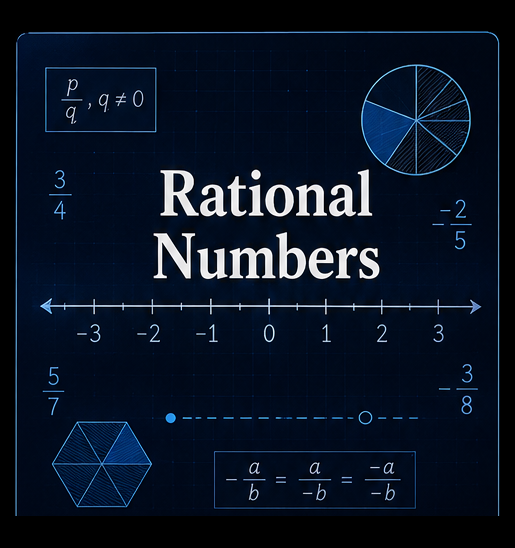
Rational Numbers
Learning Objectives
Understand the concept of rational numbers and how they extend the number system beyond integers. Learn how to write rational numbers in standard form, represent them on a number line, compare and simplify fractions, identify additive and multiplicative inverses, apply the properties of rational numbers, and find rational numbers between any two given numbers through solved examples and practice questions.
Introduction to Rational Numbers
Rational numbers are an important part of mathematics because they help us represent quantities that cannot always be expressed as whole numbers. Everyday situations such as sharing food equally, measuring distances, calculating discounts, and expressing probabilities often require the use of fractions. Every rational number can be written in the form p/q, where p and q are integers and q is not equal to zero. Since division by zero is impossible in mathematics, a fraction with a denominator of zero is not considered a rational number.
Rational numbers include positive fractions, negative fractions, zero, whole numbers, and integers. For example, 5 can be written as 5/1, and 0 can be written as 0/1. This means that every integer and every whole number is also a rational number.
Standard Form of Rational Numbers
A rational number is said to be in its standard form when the numerator and denominator have no common factor other than 1, and the denominator is always positive. To write a rational number in standard form, divide both the numerator and denominator by their greatest common factor. If the denominator is negative, shift the negative sign to the numerator so that the denominator becomes positive.
For example, the fraction 12/18 is simplified to 2/3, while 3/-5 is written as -3/5 in standard form. Writing rational numbers in their simplest form makes calculations easier and helps compare different fractions accurately.
Absolute Value of Rational Numbers
The absolute value of a rational number represents its distance from zero on the number line without considering its direction. Therefore, both positive and negative forms of the same rational number have the same absolute value.
For example, the absolute value of 3/5 and -3/5 is 3/5. Absolute value is always non-negative because distance can never be negative.
Properties of Addition
Addition of rational numbers follows several important mathematical properties. The Closure Property states that the sum of any two rational numbers is always another rational number. The Commutative Property shows that changing the order of addition does not change the answer. Similarly, the Associative Property explains that changing the grouping of three or more rational numbers does not affect the final sum.
The number 0 is called the Additive Identity because adding zero to any rational number leaves it unchanged. Every rational number also has an Additive Inverse, which is the same number with the opposite sign. Adding a rational number and its additive inverse always gives zero.
Properties of Multiplication
Multiplication of rational numbers also follows several important properties. The product of two rational numbers is always another rational number, satisfying the Closure Property. Multiplication is both Commutative and Associative, meaning the order and grouping of numbers do not change the final product.
The number 1 is called the Multiplicative Identity because multiplying any rational number by one leaves it unchanged. Every non-zero rational number also has a Multiplicative Inverse, or reciprocal, obtained by interchanging the numerator and denominator. Multiplying a rational number by its reciprocal always gives one.
Multiplication also satisfies the Distributive Property, where multiplication can be distributed over addition and subtraction to simplify calculations.
Subtraction and Division of Rational Numbers
Although subtraction and division of rational numbers are always possible (except division by zero), they do not satisfy all mathematical properties. Both operations satisfy the Closure Property, but neither follows the Commutative Property nor the Associative Property.
This means changing the order or grouping of numbers during subtraction or division changes the final answer. Students should therefore solve these operations carefully by following the correct order of calculation.
Division by a rational number is performed by multiplying the first rational number with the reciprocal of the second rational number. However, division by zero is undefined and should never be attempted.
Representation on the Number Line
Rational numbers can be represented accurately on a number line by dividing the space between two consecutive integers into equal parts according to the denominator. The numerator then determines the exact position of the rational number.
Positive rational numbers are located to the right of zero, while negative rational numbers lie to the left. The number line provides an easy visual method for comparing rational numbers and understanding their relative positions.
Finding Rational Numbers Between Two Numbers
One of the unique properties of rational numbers is that infinitely many rational numbers exist between any two given rational numbers. One simple method is to calculate the average of the two numbers, while another method involves converting both fractions into equivalent fractions with a common denominator before identifying numbers between them.
This property makes the rational number system dense, meaning there is never a situation where two rational numbers have no other rational number between them.
Applications of Rational Numbers
Rational numbers are used extensively in everyday life. They help us calculate profits and discounts while shopping, measure lengths and weights, prepare recipes using fractional quantities, calculate marks and percentages, divide objects equally, and solve scientific and engineering problems involving measurements and ratios.
Mastering rational numbers provides the foundation for algebra, geometry, and many advanced mathematical concepts taught in higher classes.
Practice Questions
- Write 18/24 in standard form.
- Find the additive inverse and multiplicative inverse of 5/8.
- Represent −3/4 on the number line.
- Find one rational number between 2/5 and 3/5.
- Does subtraction satisfy the commutative property for rational numbers? Explain.
Answer Key
ANSWER 1
The greatest common factor of 18 and 24 is 6. Dividing both numerator and denominator by 6 gives 3/4, which is the standard form.
ANSWER 2
The additive inverse of 5/8 is −5/8, while its multiplicative inverse is 8/5.
ANSWER 3
Divide the interval between 0 and −1 into four equal parts. The third division from zero represents −3/4.
ANSWER 4
One rational number between 2/5 and 3/5 is 1/2.
ANSWER 5
No. Subtraction is not commutative because changing the order of subtraction changes the answer. For example, 2/3 − 1/3 = 1/3, whereas 1/3 − 2/3 = −1/3.
परिमेय संख्याएँ
सीखने के उद्देश्य
परिमेय संख्याओं की अवधारणा को समझें तथा जानें कि ये पूर्ण संख्याओं और पूर्णांकों से आगे संख्या पद्धति का विस्तार कैसे करती हैं। परिमेय संख्याओं को मानक रूप में लिखना, संख्या रेखा पर निरूपित करना, तुलना करना, विभिन्न गुणधर्मों का प्रयोग करना, योज्य एवं गुणात्मक प्रतिलोम ज्ञात करना तथा दो परिमेय संख्याओं के बीच अन्य परिमेय संख्याएँ ज्ञात करना सीखें।
परिमेय संख्याओं का परिचय
परिमेय संख्याएँ गणित का एक महत्वपूर्ण भाग हैं क्योंकि अनेक वास्तविक जीवन की परिस्थितियों में हमें भिन्नों और दशमलवों की आवश्यकता होती है। किसी वस्तु को बराबर भागों में बाँटना, दूरी मापना, प्रतिशत निकालना तथा अनुपात व्यक्त करना परिमेय संख्याओं की सहायता से सरल हो जाता है।
कोई भी संख्या जो p/q के रूप में लिखी जा सके, जहाँ p और q पूर्णांक हों तथा q ≠ 0 हो, उसे परिमेय संख्या कहते हैं। हर पूर्ण संख्या, पूर्णांक और भिन्न एक परिमेय संख्या है क्योंकि उन्हें भी इस रूप में लिखा जा सकता है। लेकिन जिस भिन्न का हर शून्य हो, वह परिमेय संख्या नहीं होती क्योंकि शून्य से भाग देना संभव नहीं है।
परिमेय संख्याओं का मानक रूप
जब किसी परिमेय संख्या के अंश और हर में 1 के अतिरिक्त कोई समान गुणनखंड न हो तथा हर सदैव धनात्मक हो, तब वह अपने मानक रूप में होती है। यदि हर ऋणात्मक हो, तो ऋण चिह्न को अंश में स्थानांतरित कर दिया जाता है।
उदाहरण के लिए 12/18 का मानक रूप 2/3 है, जबकि 3/-5 को -3/5 लिखा जाता है। मानक रूप में लिखने से गणनाएँ सरल हो जाती हैं तथा भिन्नों की तुलना आसानी से की जा सकती है।
परिमेय संख्याओं का निरपेक्ष मान
किसी परिमेय संख्या का निरपेक्ष मान संख्या रेखा पर शून्य से उसकी दूरी को दर्शाता है। इसमें संख्या के धनात्मक या ऋणात्मक होने का कोई महत्व नहीं होता।
इसलिए 3/5 तथा −3/5 दोनों का निरपेक्ष मान 3/5 ही होता है। निरपेक्ष मान सदैव धनात्मक या शून्य होता है।
योग के गुणधर्म
परिमेय संख्याओं का योग करने पर प्राप्त परिणाम भी सदैव एक परिमेय संख्या होता है। इसे संवृत गुण कहते हैं। योग में क्रम बदलने से उत्तर नहीं बदलता, जिसे क्रमविनिमेय गुण कहा जाता है। इसी प्रकार तीन या अधिक परिमेय संख्याओं का समूह बदलने पर भी योग समान रहता है, जिसे सहचारिता गुण कहते हैं।
संख्या 0 योग का योज्य तत्समक है क्योंकि किसी भी परिमेय संख्या में शून्य जोड़ने पर उसका मान नहीं बदलता। प्रत्येक परिमेय संख्या का एक योज्य प्रतिलोम भी होता है, जिसे जोड़ने पर परिणाम शून्य प्राप्त होता है।
गुणन के गुणधर्म
दो परिमेय संख्याओं का गुणनफल भी सदैव एक परिमेय संख्या होता है। गुणन में क्रम बदलने या संख्याओं का समूह बदलने से उत्तर नहीं बदलता। इसलिए गुणन, संवृत, क्रमविनिमेय तथा सहचारिता गुणों का पालन करता है।
संख्या 1 गुणन का गुणात्मक तत्समक है क्योंकि किसी भी परिमेय संख्या को 1 से गुणा करने पर उसका मान अपरिवर्तित रहता है।
प्रत्येक शून्य के अतिरिक्त परिमेय संख्या का एक गुणात्मक प्रतिलोम (व्युत्क्रम) होता है, जिसे अंश और हर को आपस में बदलकर प्राप्त किया जाता है। किसी संख्या और उसके व्युत्क्रम का गुणनफल सदैव 1 होता है।
गुणन वितरण गुण का भी पालन करता है, जिसके द्वारा जोड़ और घटाव वाली अभिव्यक्तियों को सरल बनाया जा सकता है।
व्यवकलन और भाग के गुणधर्म
परिमेय संख्याओं में घटाव और भाग करना संभव है, लेकिन ये दोनों क्रियाएँ क्रमविनिमेय तथा सहचारिता गुणों का पालन नहीं करतीं। इसलिए इन क्रियाओं में क्रम बदलने पर उत्तर बदल जाता है।
भाग करते समय दूसरी परिमेय संख्या के व्युत्क्रम से गुणा किया जाता है। ध्यान रहे कि किसी भी संख्या को शून्य से भाग नहीं दिया जा सकता।
संख्या रेखा पर परिमेय संख्याओं का निरूपण
संख्या रेखा पर परिमेय संख्या को दर्शाने के लिए दो क्रमागत पूर्णांकों के बीच हर के अनुसार समान भाग बनाए जाते हैं। फिर अंश के अनुसार उचित स्थान चुना जाता है।
धनात्मक परिमेय संख्याएँ शून्य के दाईं ओर तथा ऋणात्मक परिमेय संख्याएँ शून्य के बाईं ओर स्थित होती हैं। संख्या रेखा की सहायता से परिमेय संख्याओं की तुलना करना भी आसान हो जाता है।
दो परिमेय संख्याओं के बीच परिमेय संख्याएँ
किसी भी दो परिमेय संख्याओं के बीच अनंत परिमेय संख्याएँ होती हैं। इन्हें ज्ञात करने के लिए दोनों संख्याओं का औसत निकाला जा सकता है या समान हर बनाकर उनके बीच आने वाली अन्य भिन्नों की पहचान की जा सकती है।
यही विशेषता परिमेय संख्याओं को अन्य संख्या समूहों से अधिक उपयोगी बनाती है।
परिमेय संख्याओं के उपयोग
परिमेय संख्याओं का उपयोग दैनिक जीवन में अनेक स्थानों पर किया जाता है। खरीदारी में छूट निकालना, प्रतिशत ज्ञात करना, लंबाई और भार मापना, भोजन की रेसिपी तैयार करना, वस्तुओं का समान वितरण करना तथा विज्ञान और अभियांत्रिकी में विभिन्न मापों की गणना करना इसके प्रमुख उपयोग हैं।
परिमेय संख्याओं की अच्छी समझ आगे चलकर बीजगणित, निर्देशांक ज्यामिति तथा उच्च गणित की नींव तैयार करती है।
अभ्यास प्रश्न
- 18/24 को मानक रूप में लिखिए।
- 5/8 का योज्य प्रतिलोम तथा गुणात्मक प्रतिलोम ज्ञात कीजिए।
- −3/4 को संख्या रेखा पर निरूपित कीजिए।
- 2/5 और 3/5 के बीच एक परिमेय संख्या लिखिए।
- क्या परिमेय संख्याओं में घटाव क्रमविनिमेय गुण का पालन करता है? कारण सहित लिखिए।
उत्तर
उत्तर 1
18 और 24 का महत्तम समापवर्तक 6 है। दोनों को 6 से भाग देने पर 3/4 प्राप्त होता है, जो इसका मानक रूप है।
उत्तर 2
5/8 का योज्य प्रतिलोम −5/8 तथा गुणात्मक प्रतिलोम 8/5 है।
उत्तर 3
0 और −1 के बीच चार समान भाग कीजिए। शून्य से बाईं ओर तीसरा भाग −3/4 को दर्शाता है।
उत्तर 4
2/5 और 3/5 के बीच एक परिमेय संख्या 1/2 है।
उत्तर 5
नहीं। घटाव क्रमविनिमेय गुण का पालन नहीं करता क्योंकि क्रम बदलने पर उत्तर बदल जाता है। उदाहरण के लिए 2/3 − 1/3 = 1/3, जबकि 1/3 − 2/3 = −1/3।